We’re on the way home from Sweden and make a pit stop in Copenhagen to stretch our legs and say hello to master illustrator Paul Bonner, who I wrote about here back in 2014.
Twelve years ago, Paul showed me the incredible watercolour paintings that formed the artwork for Mutant Chronicles, the techno-fantasy universe that occupied countless hours of my youth.
This time, my eight-year-old son Benji is with me. I’ve told him a lot about Paul and his fantastical worlds, and he’s already a big fan of board games and the artwork that brings them to life.
When he was six, Benji used Paul’s book Out of the Forests for a school project focusing on one of his greatest fascinations: dinosaurs. Towards the end of the book are some of Paul’s incredible dinosaur paintings and, as it turns out, Paul might be the biggest dinosaur nerd of them all.
As Paul opens the door, Benji wanders into the living room as if he’s been here a hundred times.
“Papa, look at this!”
On the wall is what appears to be the head of a triceratops. Paul asks whether we’ve seen “the other guy” in the hallway.
We haven’t.
We follow him back to discover the most lifelike, terrifying T-Rex head imaginable. Benji walks right up to it and studies it closely.
“How did you make it?”
“It’s made of toilet paper,” says Paul, smiling.
“Where’s the rest of it? In the other room?”
“I don’t know,” Paul replies, laughing.
We head downstairs to Paul’s studio, where he shows us some of the things he’s working on, along with his extraordinary collection of dinosaurs. There are enough colourful, weird and wonderfully scary creatures here to keep any kid occupied for weeks.
Benji tells Paul that he likes drawing too. Paul encourages him to keep going.
“Draw the things you like,” he suggests. “Start by looking in books and seeing what other people have done. Copy the stuff you like. That’s how you learn.”
I don’t say anything to Paul, but as we leave I find myself thinking that he should run a summer camp for kids who love drawing, painting and making stuff.
Perhaps they could make the rest of that T-Rex too. It would be the coolest thing ever. And, judging by the look on Benji’s face, he’d be first in line.
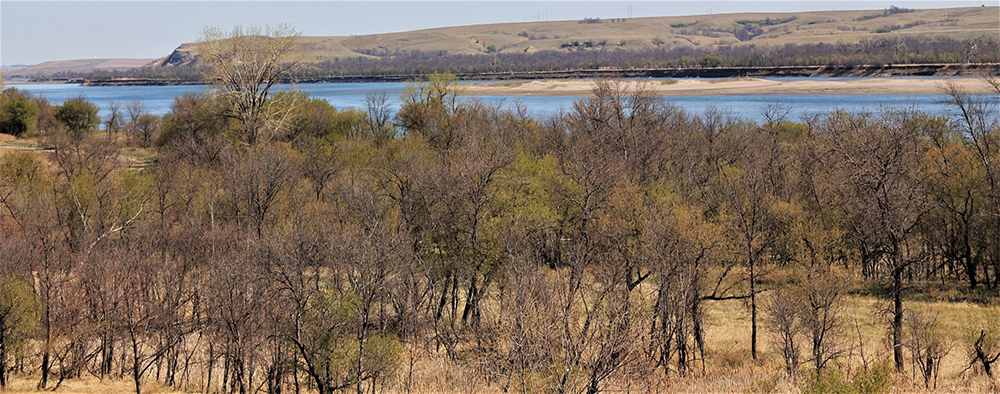
I am standing on a bluff looking out over the Missouri River in North Dakota. There is a stillness and quiet here, only broken by the sound of Red-wing Blackbird song, Chorus Frog call and the distant sound of Canada Geese. Tears roll down my cheeks; I am here at last. A lifetime of reading, studying and dreaming about this place is fulfilled. This is a highpoint of my Western American road trip in the Spring of 2015.
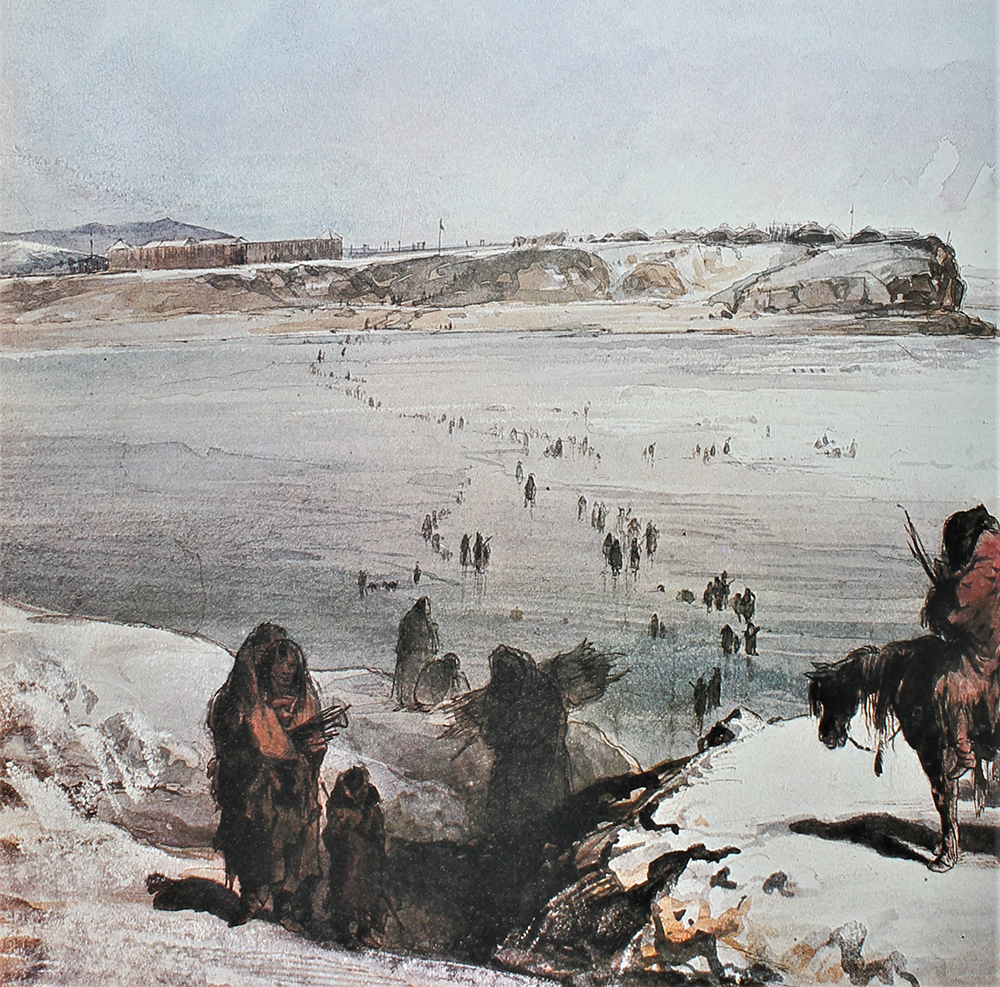
Karl Bodmer. Fort Clarke in the winter of 1833-4
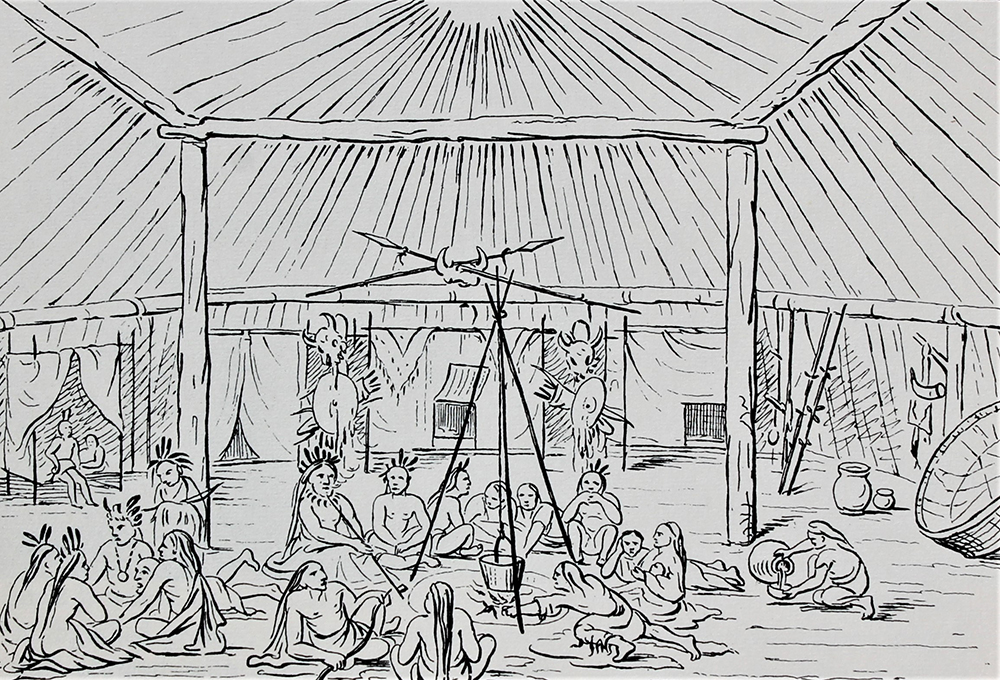
Although now empty of human activity, on this very spot in 1832 stood the rough and ready, wooden-pallisaded trading post, Fort Clarke. Close by was the Mandan village of Mih-Tutta-Hang-Kush. The lives of the Mandan people was chronicled by two artists. George Catlin visited them in 1832 and Karl Bodmer travelled in the Prince Maximillian expedition of the Upper Missouri River in the winter of 1833-4. Prince Maximillian was an explorer and chronicler. His ethnologic notes with Bodmer’s watercolours made up his treatise on the Mandans, supplementing and corroborating the relevant parts of Catlin’s vast work on North American indians. These men brought to the outside world a visual picture of the native peoples of this region before white influence changed their culture and appearance for ever. They anticipated the tragic future of the Indians. I first saw their drawings and pictures when I was eight years old. They left me with a fascination for everything and anything to do with North American indians.
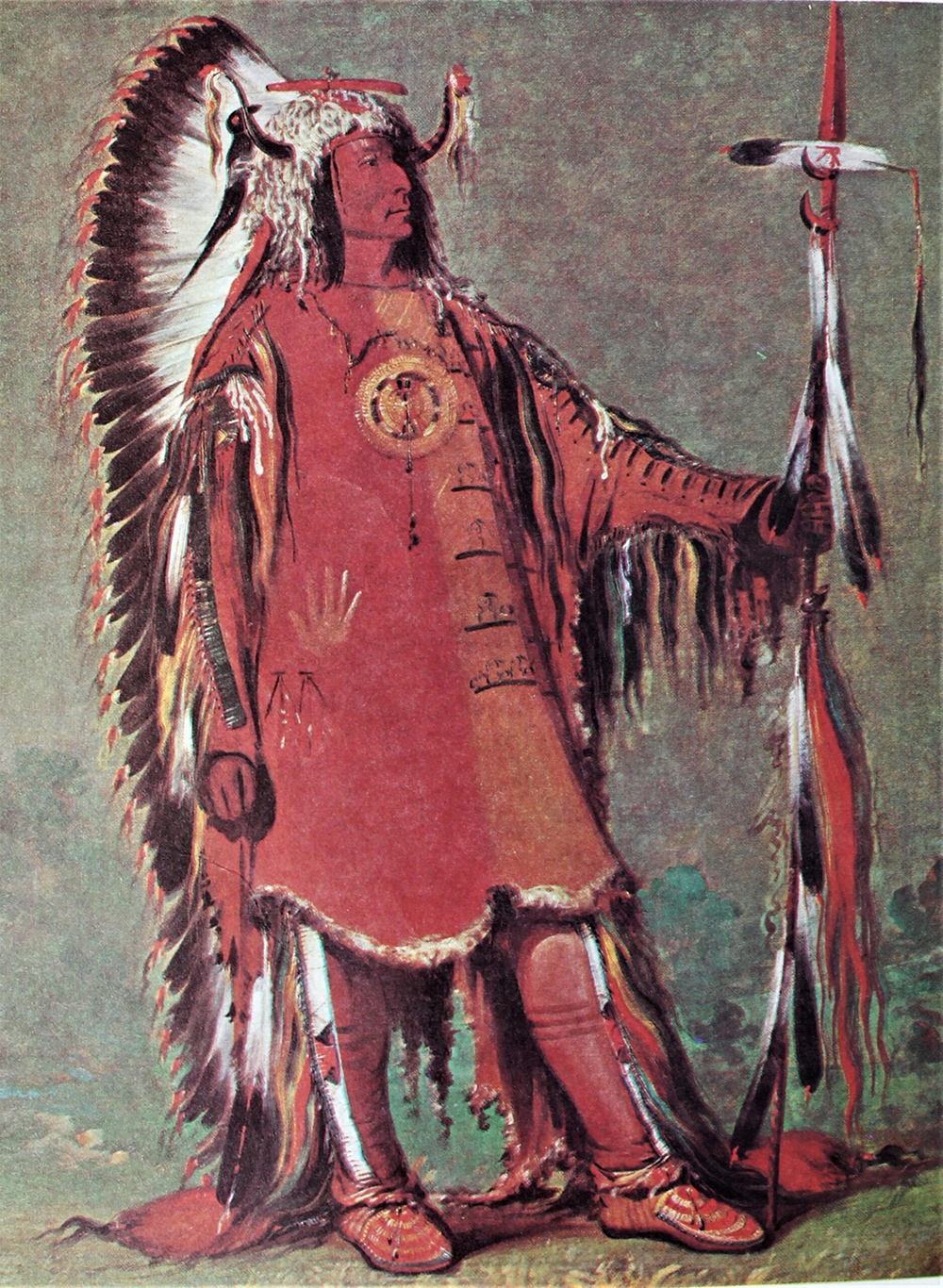
George Catlin: Portrait of Mah-to-toh-pa
Mah-to-toh-pa (Four Bears), was a Mandan hero and head man. He was also a veteran of the O-kee-pa torture ritual that was witnessed by Catlin. In 1832 Catlin wrote “Oh! “horribile visu – et mirabile dictu!” Thank God, it is over, that I have seen it, and am able to tell it to the world”. He was the only white man ever to witness the O-kee-pa ritual of the Mandan. As a boy, I soaked up accounts of these horrors; they served only to deepen my interest in a people and a culture that was so far removed from anything I knew.
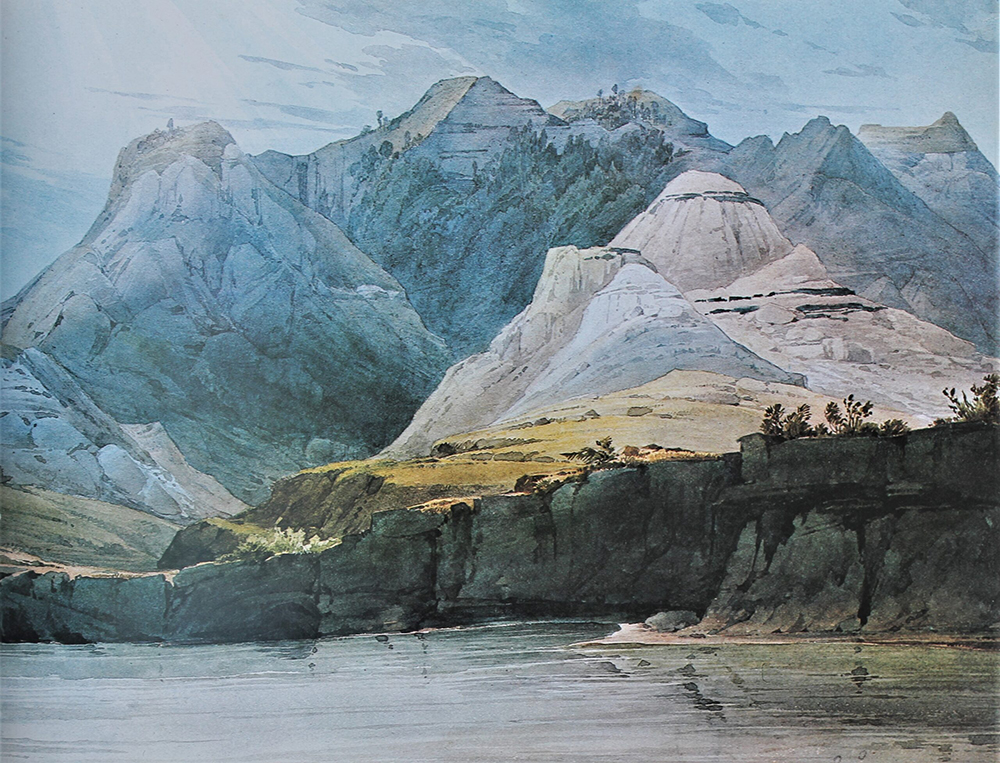
Karl Bodmer: The banks of the Missouri River
Bodmer was a watercolourist in the Victorian style and painted the landscapes that the expedition traversed, the wildlife and the peoples of the Missouri River. Catlin painted in oils and rendered fine drawings in pen and ink. He later painted many exquisite and historically important portraits of Indians from across America. His energy and his output was extraordinary. As you can imagine these guys were tough. They witnessed violence and murder and endured incredible hardships in order to feed their desire to discover and chronicle those discoveries. The journey up the Missouri by boat from St Louis to the Mandan country took three months! I just drove there, parked my car and wandered around to explore! We owe these men a great debt.
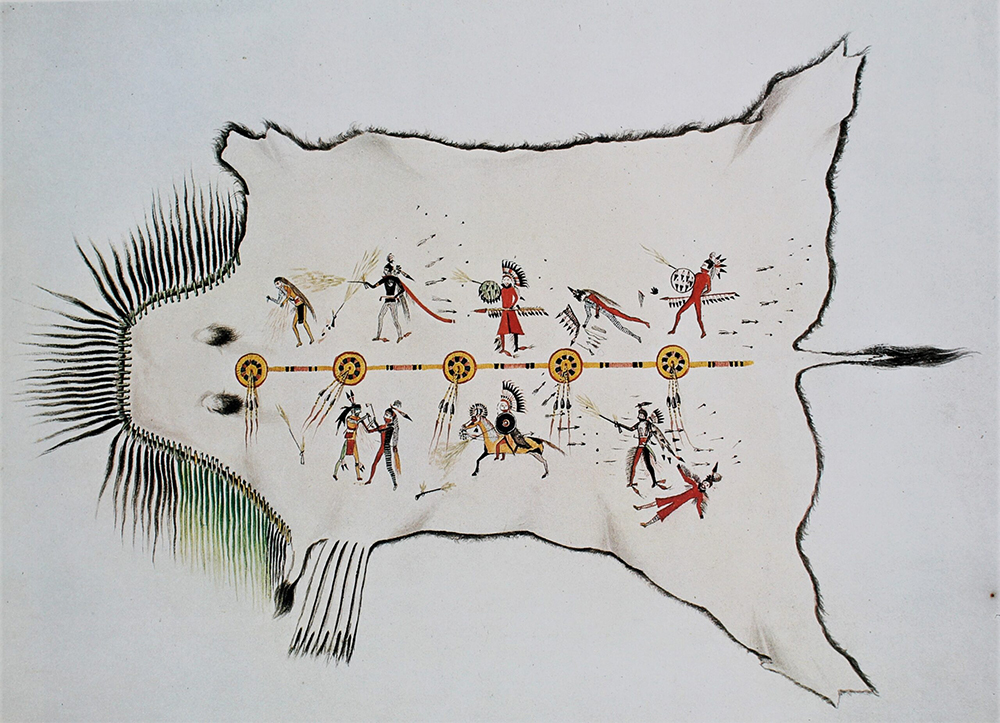
Karl Bodmer: A Mah-to-toh-pas robeGeorge Catlin: Drawing of an interior of a Mandan lodge
Artists who have also served as chroniclers include war artists, court artists and scientific illustrators. The reason for their creating is quite different from simply rendering a thing of beauty or an idea. They speak to us of the times and from the times in which they worked. Their work, unlike the written chronicle, has an inbuilt honesty to it. They are much less likely, or even able, to exaggerate or lie; for their reference sits before them and often with witnesses.
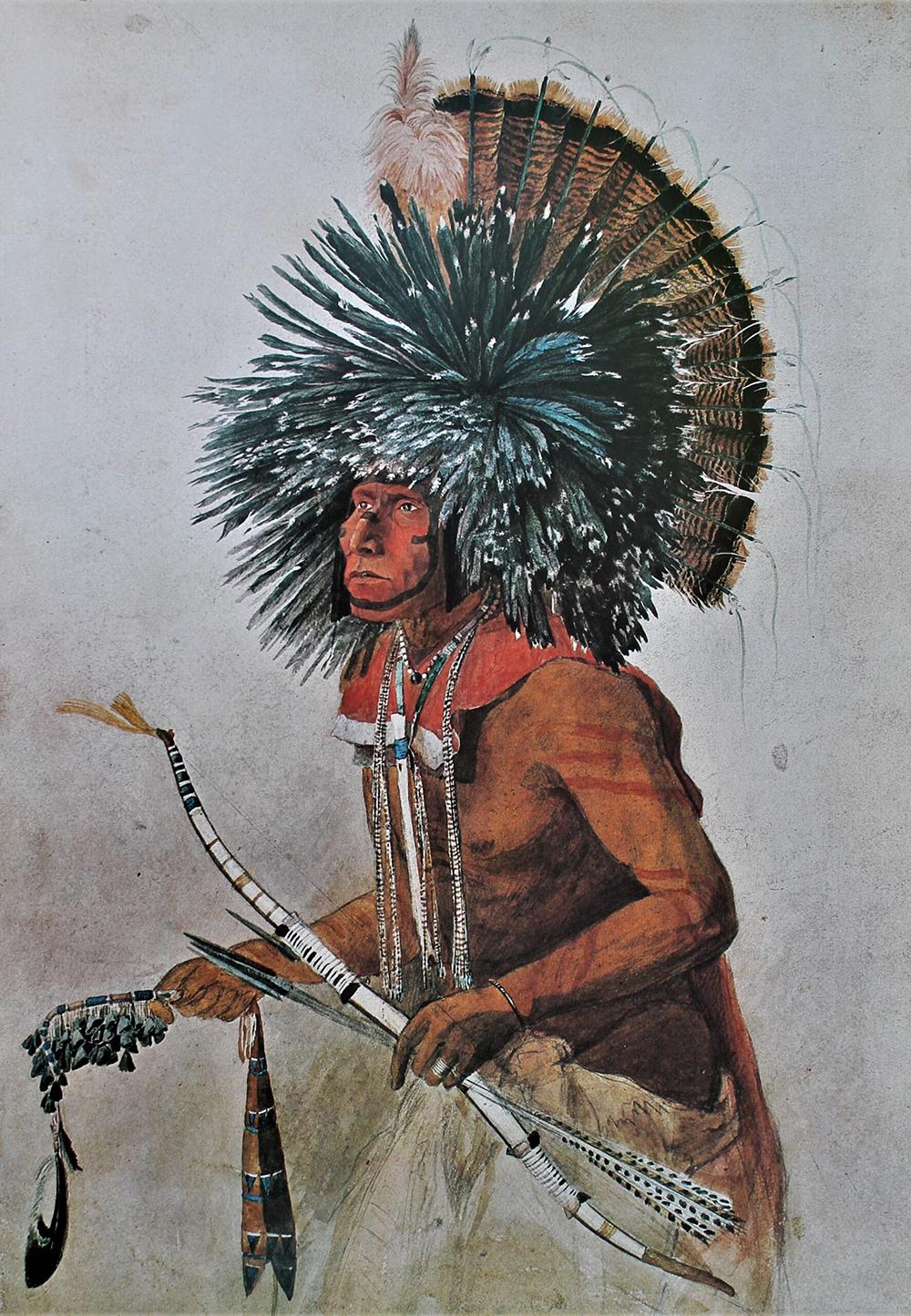
Karl Bodmer: Portrait of Pehriska-Ruhpa
This portrait is a watercolour of a Minnetaree man, and friend of Mah-to-toh-pa, Pehriska-Ruhpa. He wears the ceremonial regalia of the Dog Band, the highest of the male orders. The Minnetarees had a shared culture with the Mandan and lived in villages further upstream. This portrait, later turned into an engraving, is considered to be the greatest ethnological rendering ever made. It accompanies a most detailed description of Pehriska-Ruhpa by Prince Maximillian.
At the time of the visits by Catlin and Bodmer, there existed only about 1,600 Mandan people. They had already been decimated by smallpox; a disease brought by white fur trappers and traders and to which the Mandans had no immunity. By 1836 the Mandan were all but extinct. Had these chroniclers got there just three years later one of the most extraordinary human cultures would be unknown today. And this brings me back to the O-kee-pa ritual.
In Letter No. 22 of his two volume work, Catlin chronicles, in full detail, the ritual where Mandan men voluntarily submitted to the most agonising tortures for the good of the people. It has to be among the most accomplished pieces of ethnologic observation and writing about the most bizarre ritual that our species has invented. It has changed how I think about mankind.
Bibliography
Bodmer pictures from: “People of the First Man. The first hand account of Prince maximillian’s expedition up the Missouri River, 1833-34.” Published by E.P. Dutton, New York, 1976.
Catlin pictures from: “Letters & Notes on the Manners, Customs & Conditions of North American Indians.” Published by Dover Publications Inc. New York, 1973.
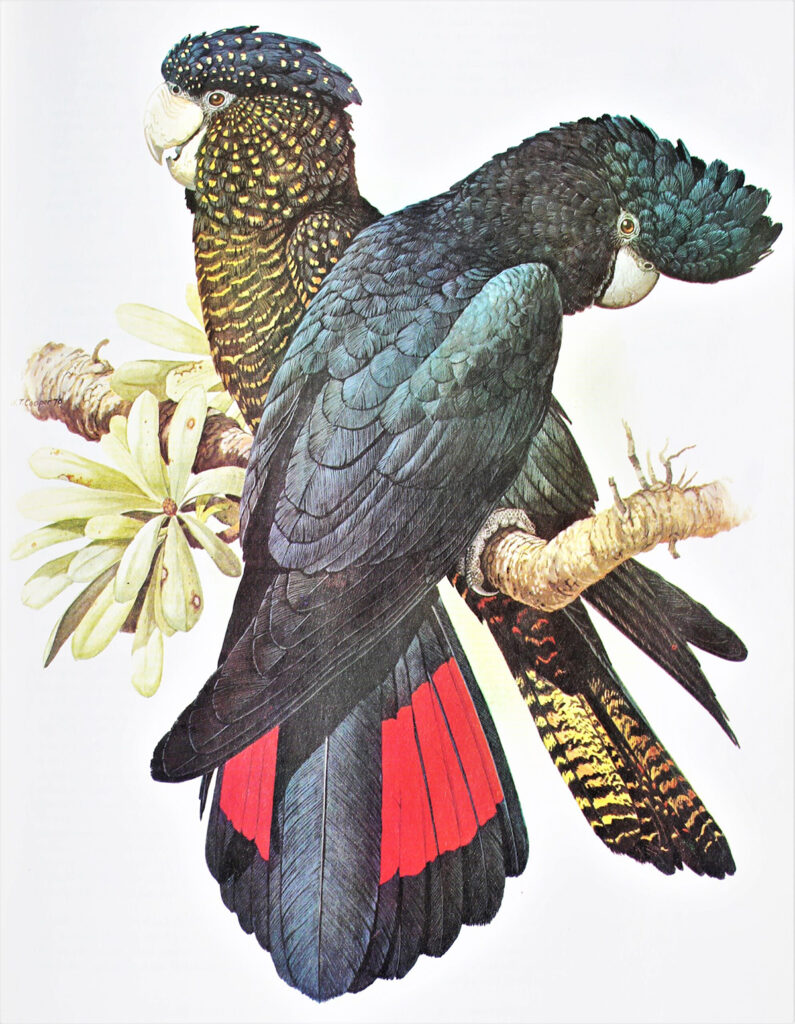
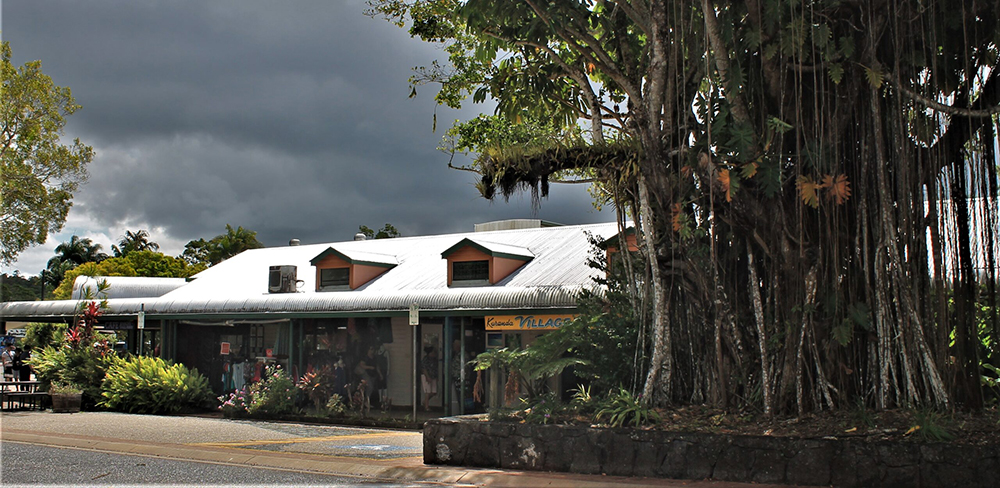
I am in the Atherton Tablelands in Queensland, Australia. I catch just a flash of colour high in the trees; one of this country’s wonderful parrots. I am reminded of a treasured book at home: Joseph M. Forshaw’s “Parrots of the World” exquisitely illustrated by William T. Cooper (Doubleday, 1978.)
At an information centre near Malanda, I have a leisurely coffee and spot a DVD for sale of a documentary by Sarah Scragg entitled “Birdman: The art of William T. Cooper.” Quite a coincidence! But then… maybe not. It turns out that this genius ornithological illustrator was Australian who lived and worked just around the corner!
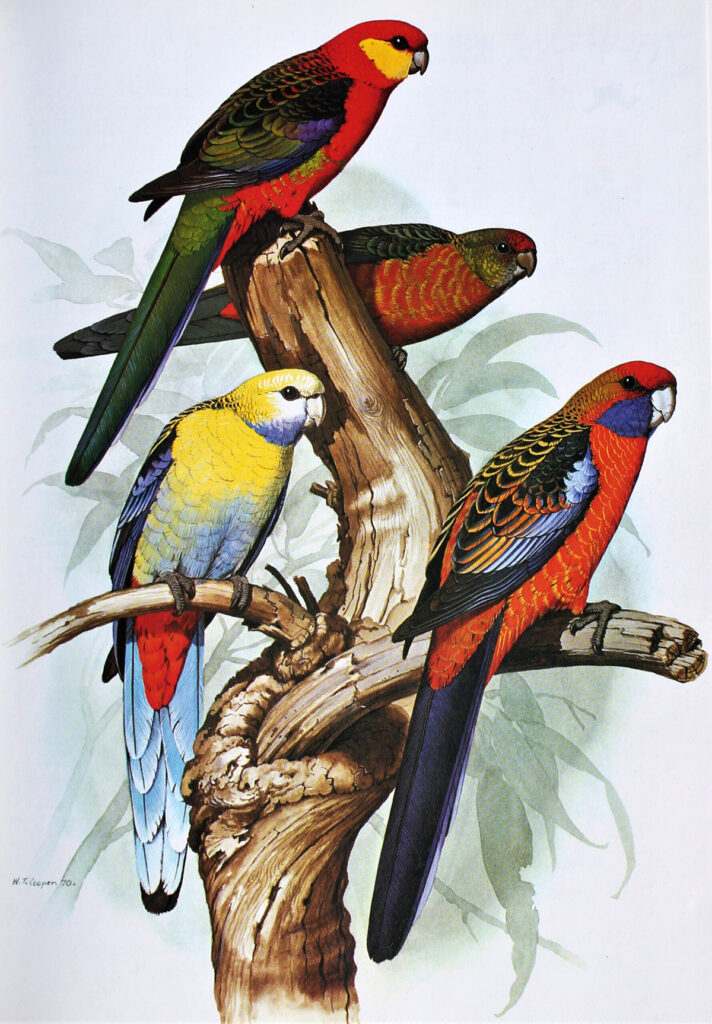
Rosella species (Platycercus Sp.)
The film briefly documents Cooper’s artistic life into his eighties but concentrates on him creating some thirty paintings for his last exhibition. It was filmed over the two years it took him to produce these works. It was fascinating to watch this modest and kindly man bring to life his subject matter on canvas. Cooper was completely likeable, described by Sir David Attenborough as ‘the best ornithological illustrator alive. You cannot better this. This is it!’ Sure is!
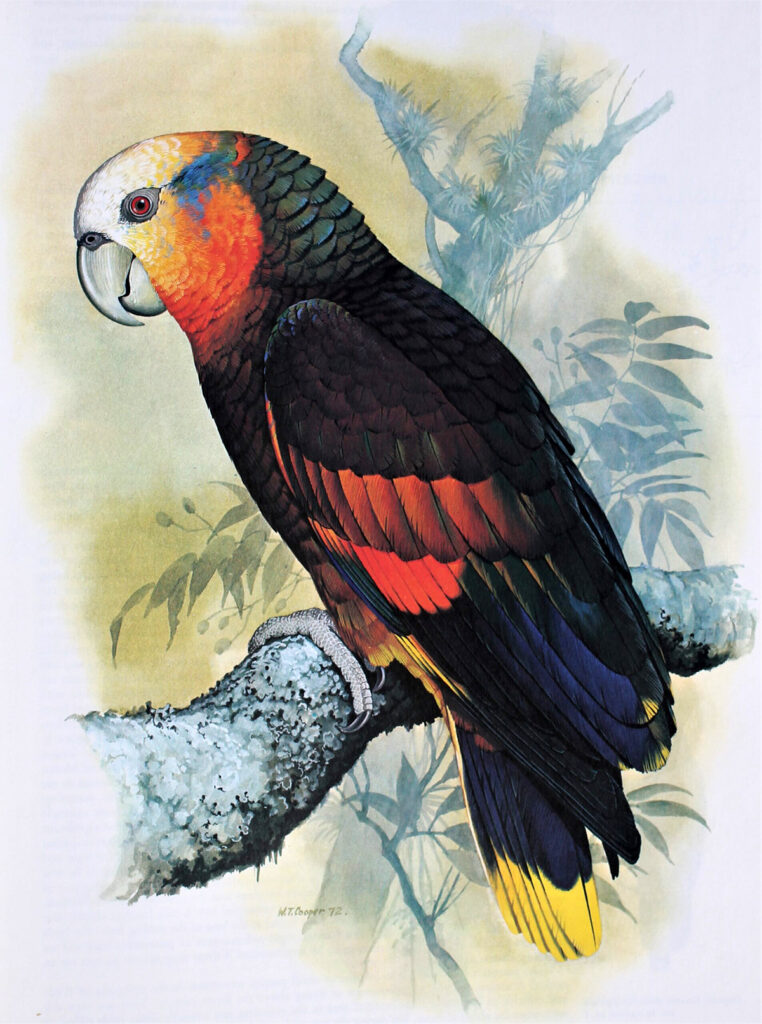
St. Vincent Amazon (Amazona guildingii)
Cooper started his career as a self-taught landscape and seascape painter. He illustrated his first bird book in 1968 and, with Foreshaw, published Parrots of The World, Birds of Paradise & Bowerbirds of The World, Kingfishers of the World, definitive works on Turacos, Bee-eaters, Hornbills and Pigeons of Australia. He must have walked the same tracks as I did through the Tablelands.
He called himself a professional bird illustrator. It was his life, his passion and his daily work. His output was prolific. Over 45 years Cooper made hundreds of astonishingly accurate and beautiful illustrations and paintings of birds. In the film, he states that as a child “birds drove me insane.” I know exactly what he means. That total absorption in the study of amphibians and reptiles is similarly an insanity for me. I recognise that ‘insanity’ – that ‘love’ – at play in his work. The birds and backgrounds are perfect.
Vulturine Parrot (Gypopsitta vulture)
The film shows Cooper collecting reference material for the backgrounds to his birds. He shot fruit down from the canopy with a powerful air rifle. He brought home lichen-covered boughs from the forest floor. Latterly, digital photography replaced his thousands of sketches of background landscapes and wildflowers. He was rare among illustrators in that he would travel abroad to sketch as many of his subjects that he could in their habitats. Often a zoo visit would have to suffice. This practise, he explains, enabled him to put that final layer of accuracy into his birds; their ‘jiz’, their essence, the characteristics that are unique to each species. His studio included drawers filled with bird skins, feathers and much more. This complete dedication to accuracy, not only in the subjects but also in the backgrounds too, makes him one of the foremost scientific Illustrators of all time. Attenborough describes the difference between Cooper’s scientific illustration, where points of identification are necessary, and the paintings that he did for exhibitions. He could be free from science then and his work takes on a liveliness not seen in his book plates. However, as evidenced by the parrots shown here, he managed to make his scientific illustrations vibrant too and Attenborough acknowledges this as one of Cooper’s greatest skills.
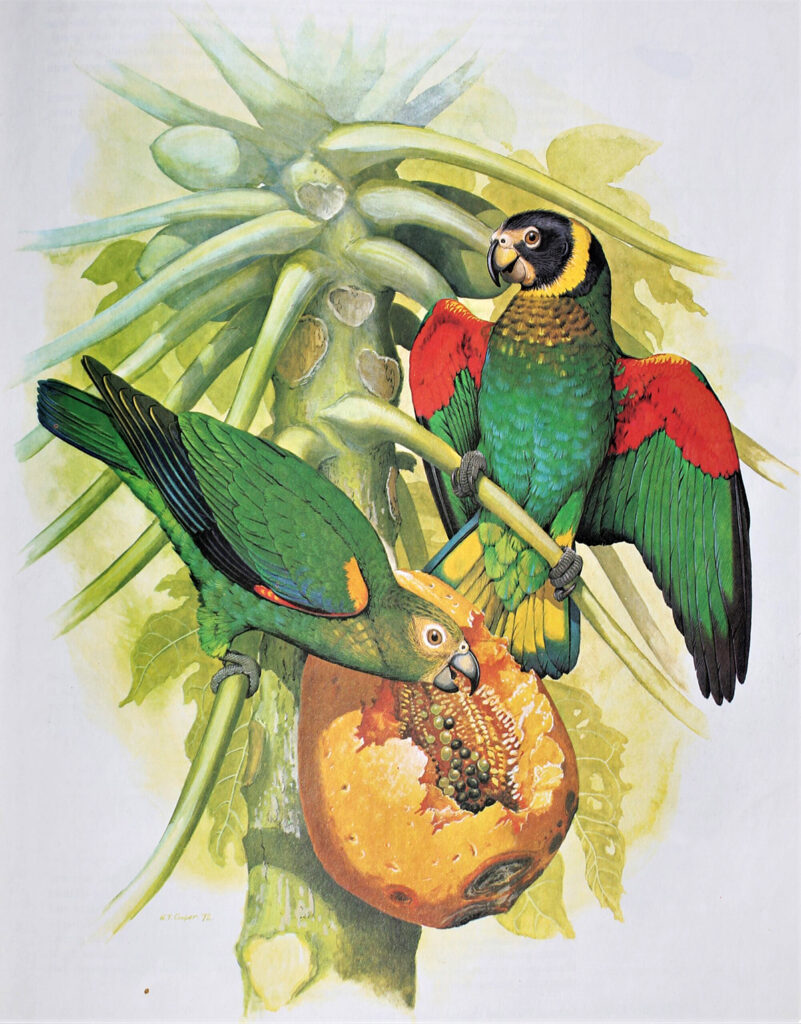
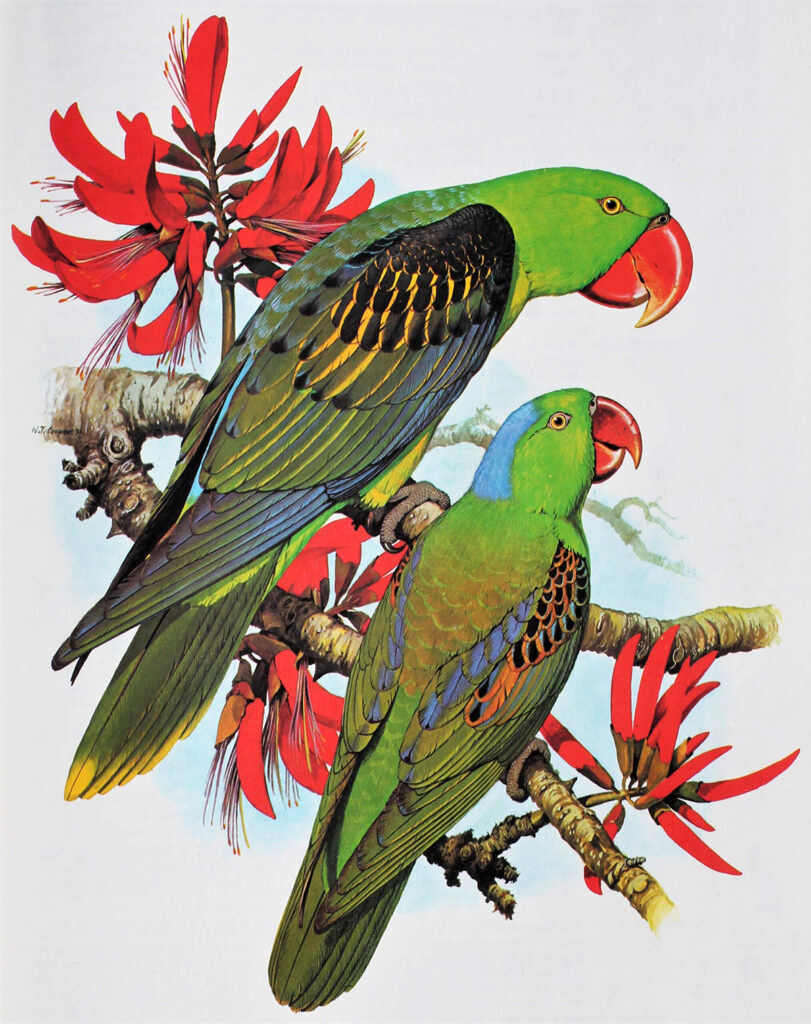
Great-billed Parrot (Tanygnathus megalorynchos) and Blue-naped Parrot (Tanygnathus luciorensis)
As I watch Cooper at work and listen to his commentary I can’t help noticing the similarities between his working methods and mine. There is dedication to accuracy. There is collection of background materials and photography of subjects for reference. He uses transparent overlays to test ideas. With a mirror he can check composition and symmetry. He speaks of often being dissatisfied with his work and will destroy the output of days if it does not reach his exacting standards. But there the similarities end. I can only stand in Cooper’s shadow. I only work in one medium whereas Cooper is master of all. My output is limited and I’ve hardly ever sold my work. Quite simply, I finally realise, I am not in the same league.
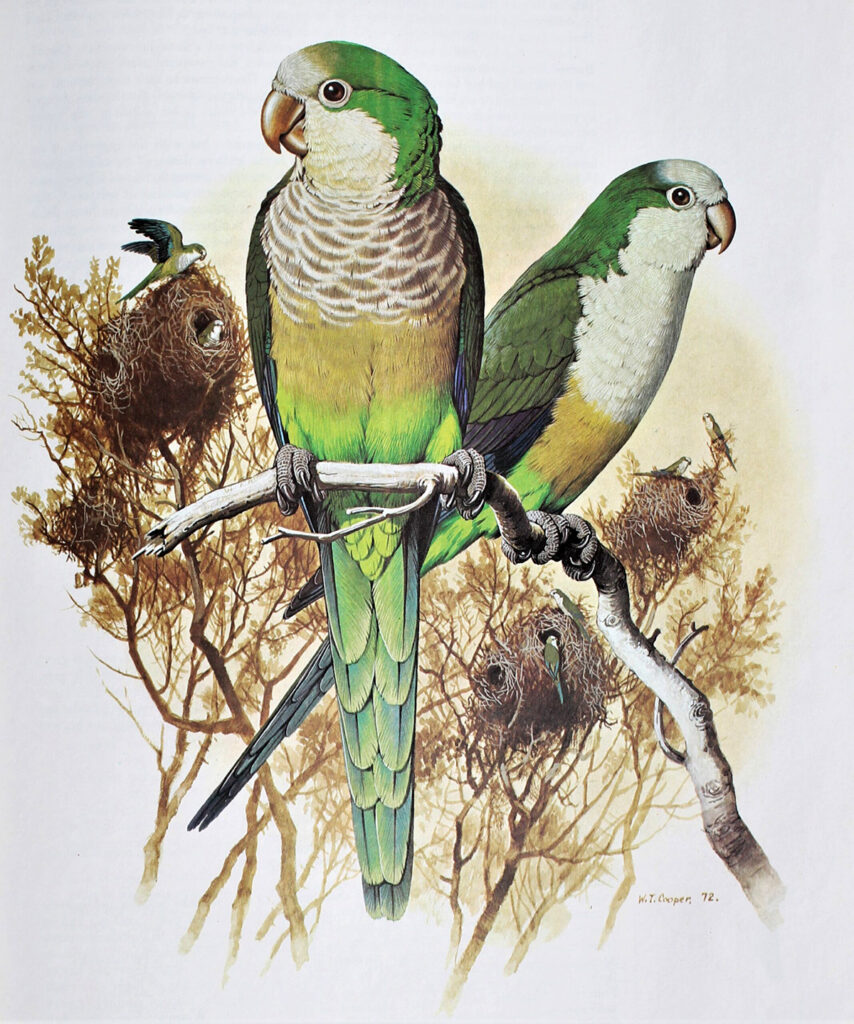
Monk Parakeet (Myiopsitta monachus)
The film ends at the exhibition. Every painting was sold within ten minutes. Cooper states that he is pleased but appears genuinely embarrassed by his success and fuss people are making of him. He can’t wait to get back to his rainforest home in Malanda to enjoy a cup of tea on his veranda; brewed precisely for five minutes as set by a timer. What a guy!