We are back in Sweden for Benji’s winter break, staying in Lindesberg, about two and a half hours west of Stockholm. I grew up here, and in many ways it still feels like home.
On the day we arrive, the temperature is a modest minus six degrees, with light snowfall drifting through the air. Mum tells us they have endured temperatures around minus fifteen for several weeks, which is quite unusual, even for this part of Sweden.
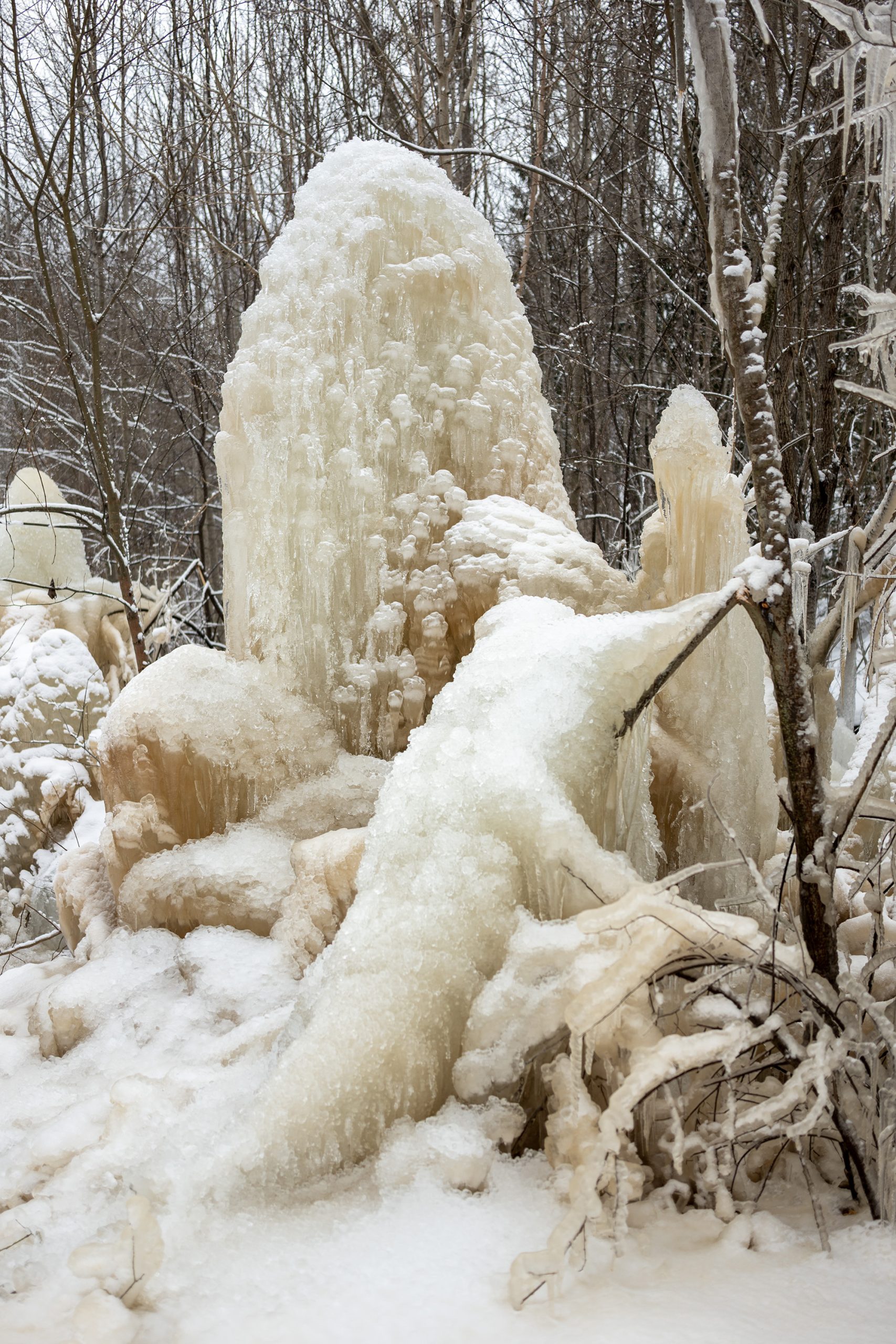
She suggests a short trip to nearby Ramsberg to see some extraordinary ice formations. I am not entirely sure what to expect. When we arrive, we discover an area beside the local hydroelectric power station completely encased in ice. And not just a little of it. From what we can tell, some of the water pipes have cracked, creating tiny sprays that shoot out in different directions.
Over the past few weeks, these fine jets of water have built layer upon layer of frozen shapes. Icicles stretch and twist into curious forms, almost sculptural, like something carefully crafted by hand rather than formed by chance. The structures feel otherworldly, as though we have landed on Krypton. There is something alien about it, crystalline and dramatic, beautiful in a slightly unsettling way.
Benji snaps off small pieces of ice and throws them, laughing as they shatter with sharp cracking sounds across the frozen ground.
Here at TBS, we usually write about who creates what, when and where, and what it means to me as the observer. In this case, I am not entirely sure who the creator is. Perhaps we can say it is Mother Nature, with a touch of inspiration from Andy Goldsworthy. Whatever the explanation, it is a fascinating sight and one I would recommend seeing soon. Very soon.
Hokitika, West Coast, South Island, New Zealand. A town with character, characters and civic pride. A town that does its own thing. A town with a beach where, in late January, the lucky tourist might come across ‘Driftwood and Sand;’ a three-day art festival where anyone and everyone creates their own ‘art’ by – and here’s the rules – using what they find on the beach. I am late on the scene. Judging is in process. Hundreds of works have been made but the festival has been marred by yesterday’s huge waves set up by a Westerly cyclone and exceptional tides. Well, what do you expect on The Coast?
Today is full sun and many of the works are still standing. Adults wander about enjoying the creativity and humour on display. Kids and dogs run around excitedly The whole scene is just so kiwi! Then there’s the constant thump and roar of breaking rollers coming in off the Tasman Sea. I take off my shoes and recall the delicious childhood feel of sand between my toes. And something else grabs a deeper part of me: the thrilling, salty-sweet, unforgettable, unforgotten seaweed smell.
‘Second wind’ by Cliff Goodwin
Essential background info: the mountainous upper reaches of the Hokitika river has recorded the highest ever annual rainfall anywhere. When it rains in the ranges that provide the backdrop to this wonderful and whacky little town. Well… it isn’t really rain. More like water falling. From height. When the river floods, whole mountain-sides slip into the torrent along with swathes of sub-tropical rain forest. All to say, there is no shortage of driftwood on Hokitika beach.
The first work to catch my eye is ‘Second Wind’ by Cliff Goodwin. This four-metre-high construction sits in defiance of the ocean it faces. There is resilience here but the harp-cum-dreamcatcher appearance makes for a delicate and even spiritual feel.
‘Looking into the fuchsia’ by Rich, Claire, Nina and Noah
Whether or not ‘Looking Into the fuchsia’ resembles a fuchsia, I love the play on words and how the concept hangs on the remains of a rather balletic tree and four piles of sea weed.
‘You’re a catch!’ by Victoria McNutt
I am mesmerised by the contents of the fine mesh of Victoria McNutt’s ‘You’re a catch!’ It has survived the storm. The fragile driftwood drape resembles a flock of seabirds. But, who is Victoria’s catch? Is she speaking to a netful of sea creatures? Or, tantalisingly, is she whispering to herself that a recently-met partner is maybe a keeper and surpasses a number of flown-away ephemeral encounters in her past? Perhaps, Victoria, you’d like to let us know!
‘Death animal. No water’ by Walter
I love ‘Death animal. No water’ for three reasons: first, stick-arrows bring the viewer to it as though to a crime scene that is cordoned off with more little sticks; second, given the title, the dead and dessicated beast is simply so convincing; third, the idea of ‘no water’ in Hokitika makes me laugh. A lot.
‘Questionable pet’ by Rowi and Cliff
I knew it would be here somewhere: the thing that stops me in my tracks. Three separate tree trunks have been used to create a majestic sea-dragon that rears out of the sand and hisses at the breaking waves. This is spine-tinglingly beautiful stuff.
The workmanship of the head and neck is in a different order. The beast’s shaggy mane and kelpy drool are sublime. The whole deserves a place in a museum. It’s tragic that ‘Questionable pet’ (fantastic understatement,) like all the other works, will be just driftwood and sand again by next week. Bravo, Rowi and Cliff! Bravo, Hokitika!
Westport Golf Club: my favourite of the wonderfully affordable links courses on the West Coast of New Zealand’s south island. It’s a club day. And a fine day. Cumulus clouds build over the Paparoa mountain range. The green fee is $NZ40 (about £17) that I leave in an ‘honesty box.’ On the first tee, I’m invited to join Graham and Frank. They’re locals. Farmers. We have a great round. They seem delighted to meet a golfer from Scotland and can’t believe what we pay to play in ‘the Old Country.’
As with most golf courses in this country, it was built in the first half of the twentieth century. New Zealand adopted the Scottish tradition of making sure that every small town has its golf club. And Westport is a small town: the current population is 4,600 whilst current membership is 200.
I meet a most welcoming club captain, Jim (of Scottish origin!) We chat. He is generous with his time. I tell him that I am always interested in what happened to such clubs during the two world wars. Helpfully, he informs me that a history of the club, founded in 1905, has been published recently. He gives me a copy. I take a seat in the club house and start to read about the early days of golf in Westport. It is an extraordinary story of how the then exclusive pastime of golf was eagerly promoted by the well-to-do section of this small mining community the population of which was about 3,800. The existing course, completed in 1927, is in fact the third; the first two being deemed unsuitable. The book is full of old illustrations of the first two courses and charming grainy photos of benefactors together with past Presidents, Captains, Green-keepers and club Champions.
Then I come to the section on ‘The War Years.’ I read that during the ‘Great’ War’ of 1914 – 1918 (that was started far away because England’s George V, Russia’s Czar Nicholas II and Germany’s Emperor Wilhelm II – all of whom were related by birth or marriage – neither liked nor trusted each other) the club was profoundly patriotic. Members believed every man’s duty was to go and fight. The President of the day went so far as to propose that ‘It is inadvisable during the continuance of the war to encourage men eligible for service to engage in the game of golf.’ In 1939, ‘The clouds of war loomed large over Westport Golf Club…. Many of the brightest and best left to serve King and Country in the fight against Naziism…’ I raise my eyes to a dark board above the front door. There it is: the Roll of Honour. This club lost 53 members in the two world wars, including five of its champions. The book does not give figures for membership before or between the two wars. What is known is that in 1948, there were 102 men and 68 women members. Do the sums!
I drive into town in a sober frame of mind. What I’m looking for is not difficult to find. As always, a memorial to the dead of two World Wars brings on a queeziness and disbelief still. It’s the numbers, you see. (And, by the way, multiply by two for an estimate of the number of wounded.) The Gates of Remembrance at the entry to the Memorial Park are as poignantly impressive as they are eye-wateringly sombre. Of course, there are columns of names of those young Westport men who didn’t come home from Gallipoli, Palestine, Somme, Messines, Passchendale and Le Quesnoy. I count. There are 298 names from World War I (about 7.5% of the population of the day) and 44 from World War II. This sort of calamity couldn’t happen again, could it? Nah!