We’ve been blogging here since 2013, and a few times we’ve wandered into space. I remember writing about Chris Hadfield’s stunning photos of Earth from the International Space Station, and about the James Webb Space Telescope in a tribute to good ol’ Hubble. Space keeps coming back. It’s endlessly fascinating and has captured my imagination since I was a kid.
So imagine my excitement when I came across Andrew McCarthy’s photograph “The Fall of Icarus.” The photo shows a parachutist falling in front of the sun. At first, I thought it must be AI-generated, because these days it’s getting harder and harder to tell what’s real and what’s not. But the story behind the photo is even more remarkable than the photo itself. And yes, it’s the real deal.
McCarthy photographed his friend Gabriel Brown through a telescope from the Arizona desert. Brown jumped from a paramotor from a height of about one kilometre. The two coordinated the timing and position by radio, and it took six attempts to get it right. To make Brown appear so small against the sun, McCarthy used an extremely long focal length and shot from roughly 2.5 kilometres away. He also used a hydrogen alpha filter on his telescope, revealing details on the sun’s surface that are normally invisible.
https://youtu.be/rDYtdUMMbxQ
Honestly, who does this kind of stuff? As a photographer myself, I am in awe. This is more than a stunning photo. It is a tribute to the people out there who put their heart, skill, and patience into creating beautiful stuff. There is passion, precision, and a sense of wonder in every part of it. I love it, and this is exactly what Talking Beautiful Stuff is all about.
If you visit McCarthy’s website, Cosmic Background, you’ll find a gallery full of truly beautiful cosmic photographs. I could easily fill all the walls in my apartment with his work. I went ahead and ordered a smaller, limited edition print of The Fall of Icarus. It arrived beautifully framed, complete with a certificate of authenticity. I can’t wait to get it up on the wall. It’s the ultimate conversation starter. I love it! Thank you, Andrew. I cannot wait to see what you do next.
I’ve been a space nerd since I was about seven, when my mum brought me to the planetarium in Stockholm. Mouth open, I looked up into this dome representing the night sky. I was immediately and totally captivated by all things space. I learnt among many other things that the speed of light is 300,000 km/second. The distance light travels in a year is the standard measure of distance in our universe. (For reference, our sun’s light takes 8.3 minutes to reach us!) Many of those distant stars are so many light years away that we perceive their light long after they exist. It’s something about space: it’s infinite immensity, it’s beauty, the countless unknowns, the big bang and, of course, the enthralling statistical certainty that, out there somewhere, other life forms are going about their business. Space remains the brimming fuel tank of my turbo-charged imagination. And this imagination morphed into excitement of unlimited scientific discovery when last year I found myself browsing through freely accessible of images from NASA’s Hubble telescope that has been orbiting our planet since 1990. Just take a look!
Image: Hubble Space Telescope. The “Pillars of Creation” is the name given to trunks of interstellar gas and dust in the Eagle Nebula, in the Serpens constellation, some 6,500–7,000 light-years from Earth. Credits: NASA, ESA, CSA, and STScI
So how much of the night sky is captured by an image like this? It’s something like making a tiny hole in a piece of paper, holding this paper up at arm’s length and capturing a very high resolution image of whatever light comes through the hole.
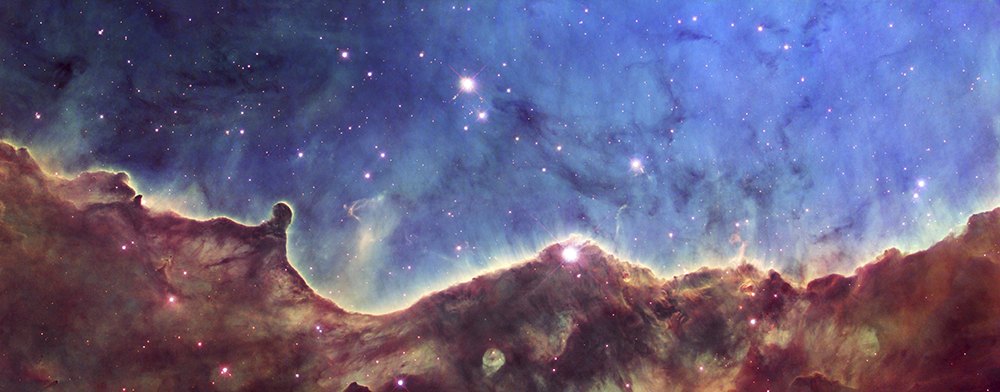
Hubble’s images of our universe are truly extraordinary. This has to be the most awe-inspiring beautiful stuff ever. Is it “art”? If so, who is the artist? The NASA photographer? Nature? A great creator? (Eek!) Here’s a Hubble image of the Carina Nebula.
Image: Hubble Space Telescope. Billowing cloud of cold interstellar gas and dust rising from a tempestuous stellar nursery located in the Carina Nebula, 7,500 light-years away in the southern constellation Carina. Credits: NASA, ESA, CSA, and STScI
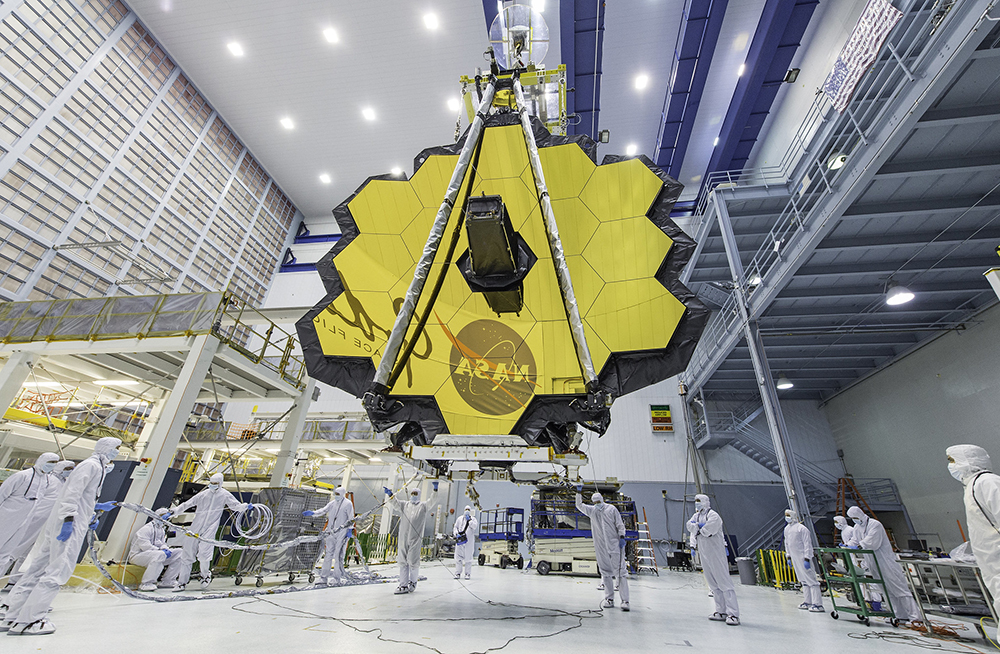
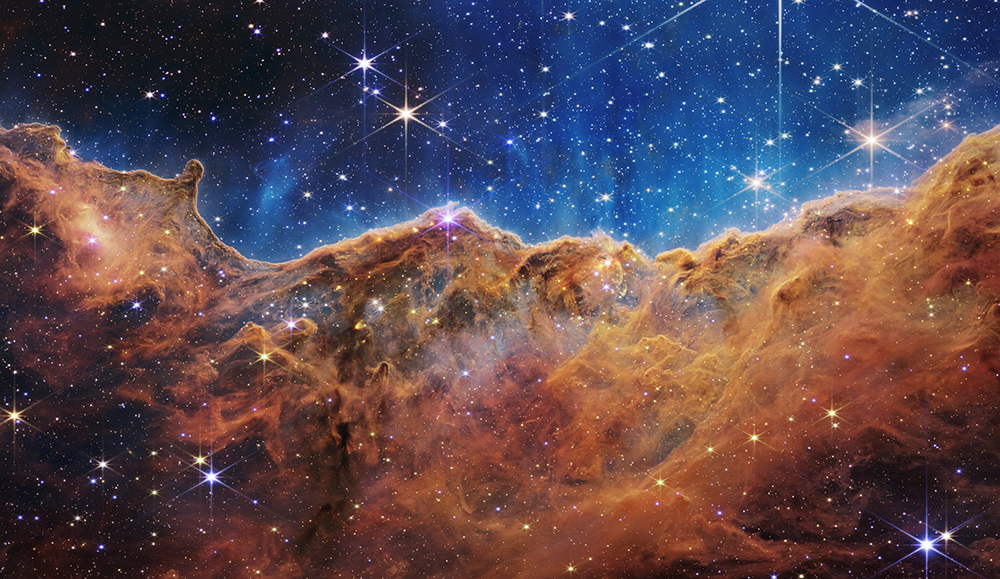
In 2003, NASA decided that they needed even better and deeper images of the universe. (Well they would, wouldn’t they!) To do this they set out to use a massive high resolution infrared camera. In December 2021, they launched the $10 billion James Webb Space Telescope and have recently published some of the first images. Included is a very different view of the Carina Nebula.
Image: Webb Space Telescope. Webb’s infrared vision is able to cut through the curtain of dust, revealing many more stars in the Carina Nebula. Credits: NASA, ESA, CSA, and STScI
The improved resolution of the Webb images is astounding and potentially bears enormous scientific fruit. For example, NASA scientists can identify even more stars that, however briefly, dim as a planet passes between the star in question and Webb’s camera. This multiplies many times over the number of planets that we know about that could potentially harbour life.
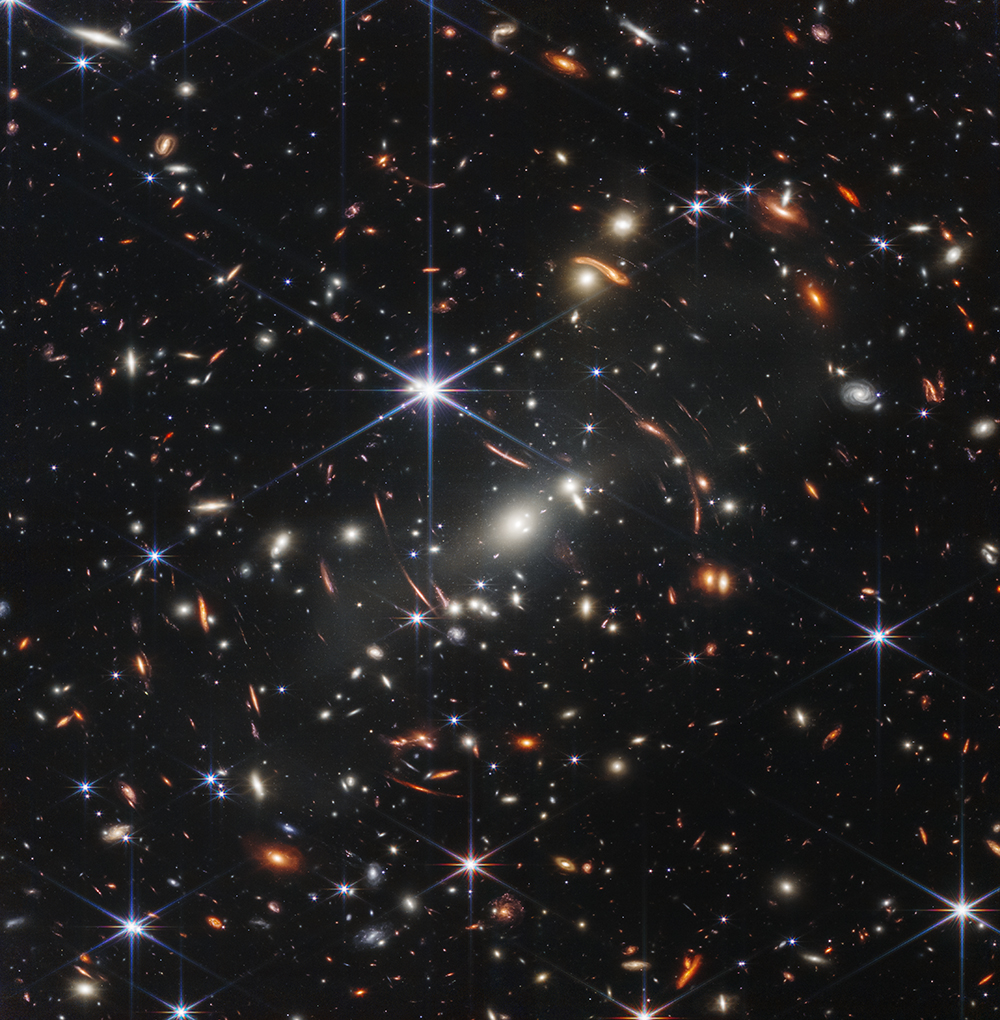
Image: Webb Space telescope: This is the deepest and sharpest infrared image of the early universe ever taken. Webb was able to capture this image in less than one day, while similar deep field images from Hubble take many weeks. Credits: NASA, ESA, CSA, and STScI
The real big trophy that Webb holds high takes the form of images made by light from stars 13 billion light years away. It is believed that these stars are the oldest in existence (if indeed they still exist!) and represent the immediate aftermath of the big bang. In other words, this image is created by light transmitted from the earliest universe and has been travelling from those stars for 13,000,000,000 years before being captured by the Webb telescope. Gosh! Images of the big bang! It’s time to grab a coffee with my buddy, Dan-Who-Knows-Stuff.
Dan-Who-Knows-Stuff once told me that there is mathematical proof that a parallel universe exists; an exact copy of us, our world and what we are doing. (Struggling!) He understands dark matter. (I don’t!) I ask him to give me a five minute tutorial on the big bang. This gets a huge smile. The story goes something like this. All matter in the universe was once contained in one lump. Nobody knows its dimensions. Possibly football size; possibly planet size. It was so dense that no light could be emitted from it. Then, for some reason, 13 billion years ago, it literally exploded and the fragments of that explosion accelerated rapidly away for a few thousand years to form our universe which, by the way, is still expanding but much more slowly. Many of the fragments are stars the matter of which can now transmit light. We know all this because light can be “dated;” it changes subtly the longer it has been travelling. We can also tell whether light is coming from a source that is moving towards us or away from us (the Doppler effect.) This is how we know that those stars, 13 billion light years away and seen for the first time by Webb represent the origin of our universe.
“Thanks, Dan-Who-Knows-Stuff!” I say. “But I have a question. If all the matter in the universe was contained in one lump, what was outside the lump?”
“I don’t know! That’s one of the two most fundamental and unanswered questions about the universe.” Says Dan-Who-Knows-Stuff.
“What’s the other question?” I ask.
Dan-Who-Knows-Stuff smiles. “What is time?” he says.
Julien Spiewak is young, talented, inspired and modest. His photographic oeuvre has been exhibited at art fairs in Rome, Rio, Seoul, Amsterdam and, significantly, Paris. I meet him at the tenth anniversary of that where-things-happen gallery, Espace L.
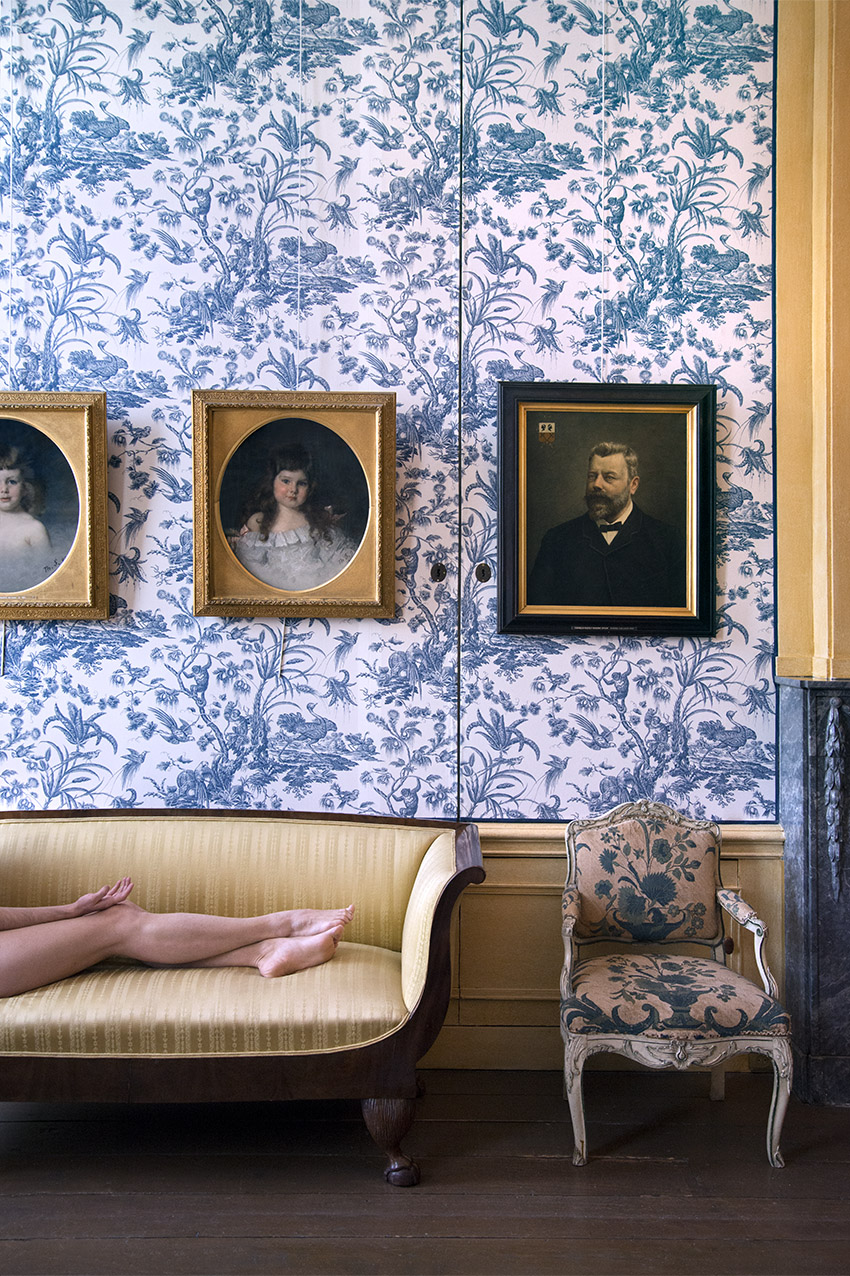
Canapé Biedermeier (XIXesiècle), portrait de Louis Marguerite van Loon par Thérèse Schwartze (1894), Juliette, fauteuil Louis XV (1750). Musée Van Loon. 2018
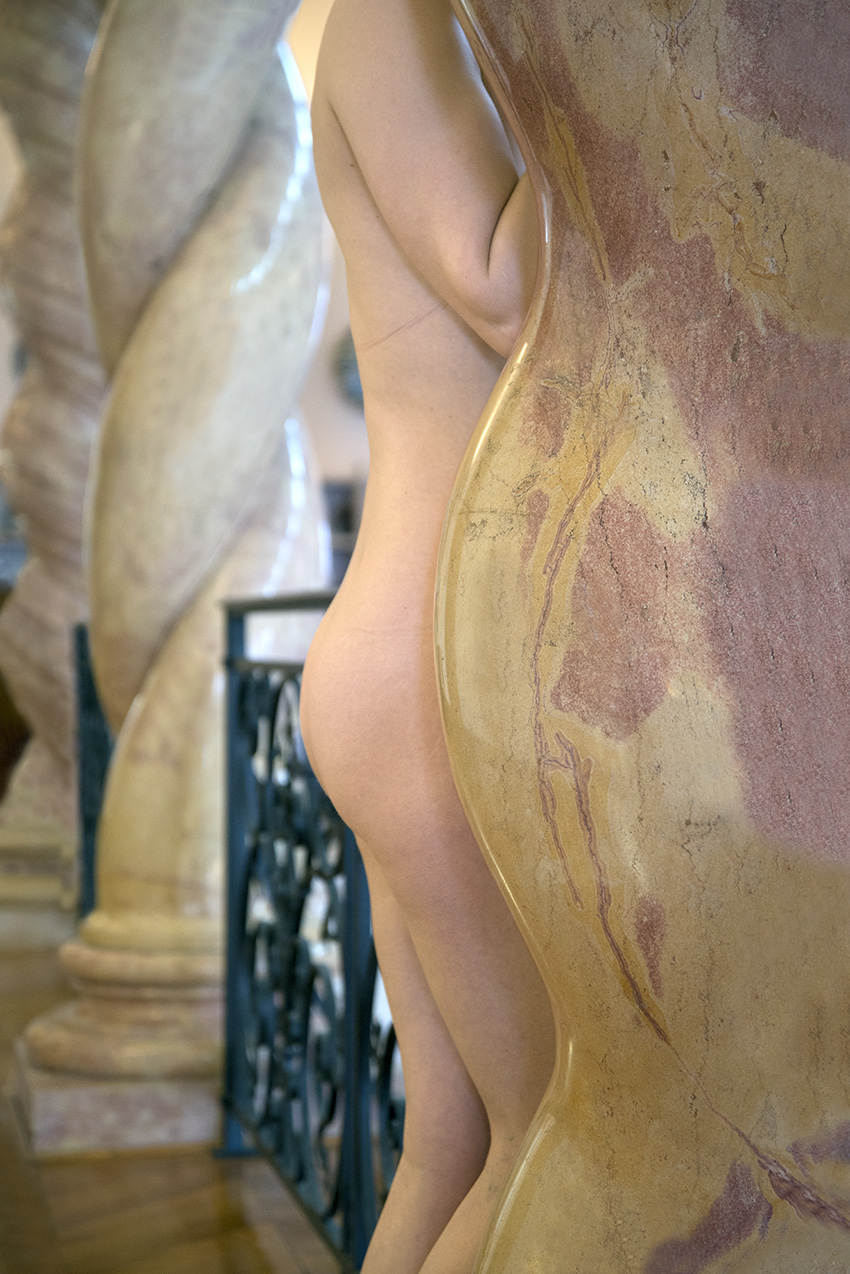
Julien took a degree in photography from the University of Paris in 2008. Since, he has with single-minded passion driven one project to considerable success: his Corps du Style (the title being a nod to the Louis XV Style.) His modus operandi comprises an intriguingly staged photograph in which only a part of his or a model’s naked body is set against furniture, painting or sculpture in the sumptuous surroundings of major museums. (Apparently, having access to an empty museum for this exercise is no mean administrative feat!) The resulting images are technically accomplished. Real beautiful stuff! At the same time, there is something a little disconcerting and even amusing in Julien’s striking contrasts between the living body part and the inanimate; the young and the old; the warm and the cold. I can’t help noticing how the rather discrete lines left by the young model’s bra play off the marble’s delicate veins.
Colonne de marbre, Carole. Musée Ariana, Ville de Genève. 2018
So far so good. Close co-operation with Espace L took Julien’s work to the Paris Art Fair in 2020. The Director of the Maison de Balzac tapped him on the shoulder, declared an admiration for his project and invited him for tea so to speak. “Have you read D’Honoré de Balzac’s Le Chef-d’Oeuvre Inconnu (Unkown Masterpiece)?” asked the Director. Julien had not… but he did soon after. Balzac’s short story, set in Paris and published in 1831, centres on the tortured soul of a painter called Frenhofer, an old master of the day. Frenhofer tries to execute a masterpiece on canvas but ends up with a chaos of colour and swirls with a protruding human foot. Reading Le Chef-d’Oeuvre Inconnu was to be a major light-bulb moment in Julien’s life because, here in Balzac’s words, were countless phrases that seemed to speak directly to his Corps de Style photographed over the preceding years.
Portrait d’Honoré de Balzac en plâtre patiné de Pierre-Eugène-Émile Hébert (1877), Julien. Maison de Balzac. 2020
Serendipity having added a new dimension to his project, Julien then set about doing his thing at the Maison de Balzac. He was also gifted a facsimile of the first edition of Le Chef-d’Oeuvre Inconnu. It’s pages with Julien’s annotations linking his photographs with Balzac’s prose are also on show at Espace L. But the story doesn’t stop there. Enter Leticia – the “L” of Espace L – who, in a former life, was a journalist and publisher. She figured that publishing a book that documents the entirety of Julien’s story and presenting the book together with some of his photographs would make a fitting event to celebrate her ten years in contemporary art in Geneva. She figured right!
Photo: Talking Beautiful Stuff
Dominique Baqué, a prominent historian of photography, has written the book’s monumental and detailed foreword that reads like an “A” graded academic treatise. She concludes that the real, living, breathing Julien Spiewak represents the incarnation of the fictional Frenhofer. Wow! If she claimed that Julien’s image-making embodies the spirit of Frenhofer, I would readily agree. However, Frehhofer’s spirit is known to live on in real paintings. Paul Cézanne strongly identified with Frenhofer and went so far as to declare “I am Frenhofer!” None other than Pablo Picasso was commissioned to illustrate Le Chef-d’Oeuvre Inconnu. He moved his studio close to a where Balzac’s story unfolded and, during World War II, painted his own very well known masterpiece, Guernica.
As I leave Espace L, I ask Julien what he will be doing in ten year’s time. Without hesitation, he answers “Just this….” I think to myself, I can believe it and by then you will have collected the highest accolades in the world of contemporary photography.