Rusty McCrushem’s Car Mash

This is a guest post by Boffy Burgoon, Art Correspondent for the Bulletin of Particle Physics.
Rusty McCrushem’s Car Mash 1

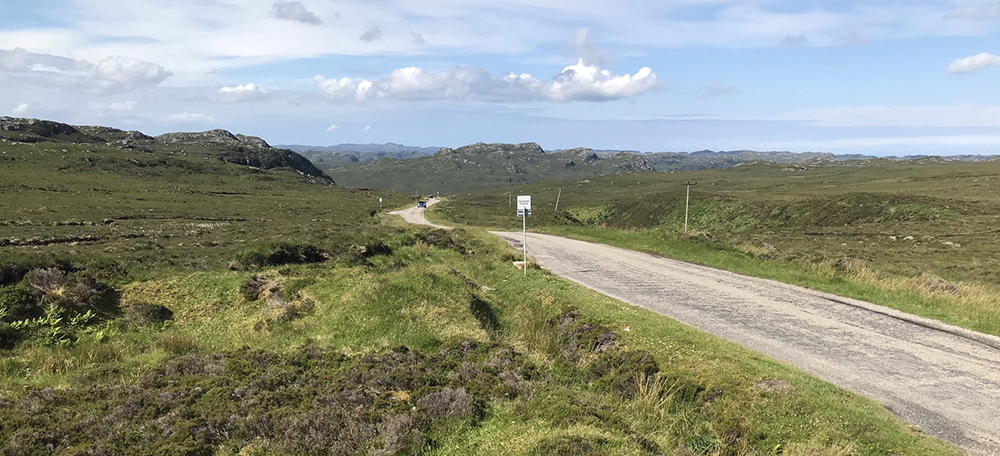
I’m on the road to Durness, Northern Scotland. Single-lane with passing places. It winds its way through some of the most majestic landscapes that Great Britain has to offer. The many motoring enthusiasts, caravanners, campervanners, hikers, bikers and cyclists who toil their way along this part of the North Coast 500 are rewarded with magnificent views of long-ago-glacier-smoothed hills, hanging valleys, gushing peat-stained rivers, lochs of an unfathomable gun-metal hue, red deer and even eagles. This is country that fills my soul.
Rusty McCrushem’s Car Mash 2

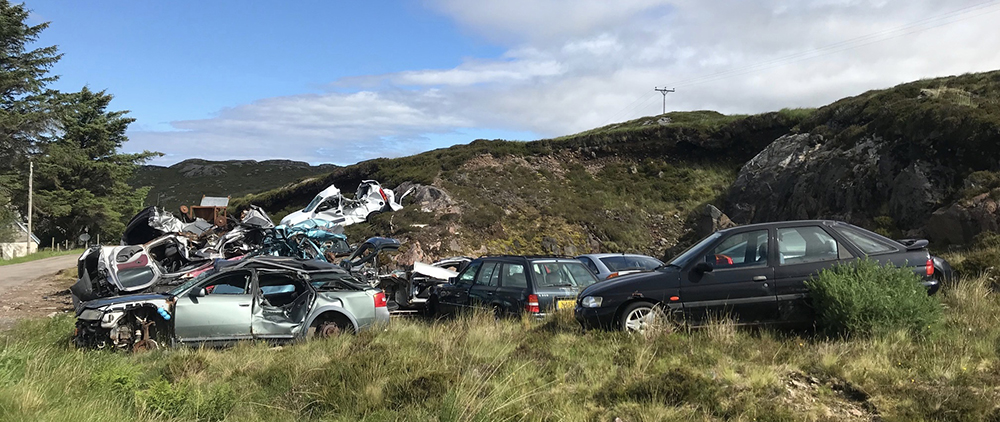
If you decide to brave the euro-touro logjam of the NC500 you may wish for a distraction albeit a distraction that is altogether startling in such an environment. Turn off the Durness Road (the A 838) at Rhichonich onto the B 801 towards Kinlochbervie. After about three kilometres, you will be confronted by Rusty McCrushem’s latest car mash installation. It is his most challenging to date. Unlike his earlier piles of rusted and discarded automobiles scattered over Scotland, this has a brilliantly thought through temporal element and takes car mashing to new heights.  

At first pass, I see only cars that are more or less in tact. Rusty teases us with the odd patch of rust, flaking paint, delicately shattered windscreens, a dented door here and a missing wheel there. These once shining objects of commerce and pride are of no further vehicular use; they are now abandoned. However, they seem somehow at ease in their weed-ridden, road-side rest home for cars. Rusty broadcasts a message for the as yet unimpressed viewer: “Och, you’ve nae seen anything yet!”
Rusty McCrushem’s Car Mash 3

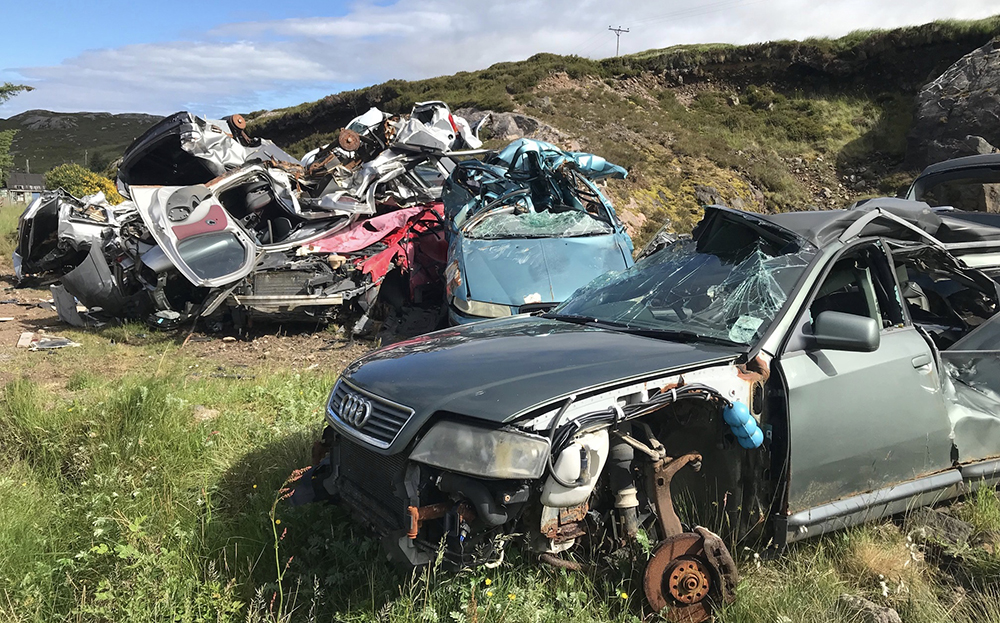
And then I notice the forces of destruction that Rusty commands. This gives the whole a kind of lambs-to-slaughter feel. Is this a sly McCrushem nod to the one-way street of universal decay?

Rusty McCrushem’s Car Mash 4

Rusty’s innate talent for mashing cars pummels the senses. The results are spectacular. I feel I have come across a scene of extraordinary violence but the screams of twisted automotive pain are stilled now. Only the curlew calls.
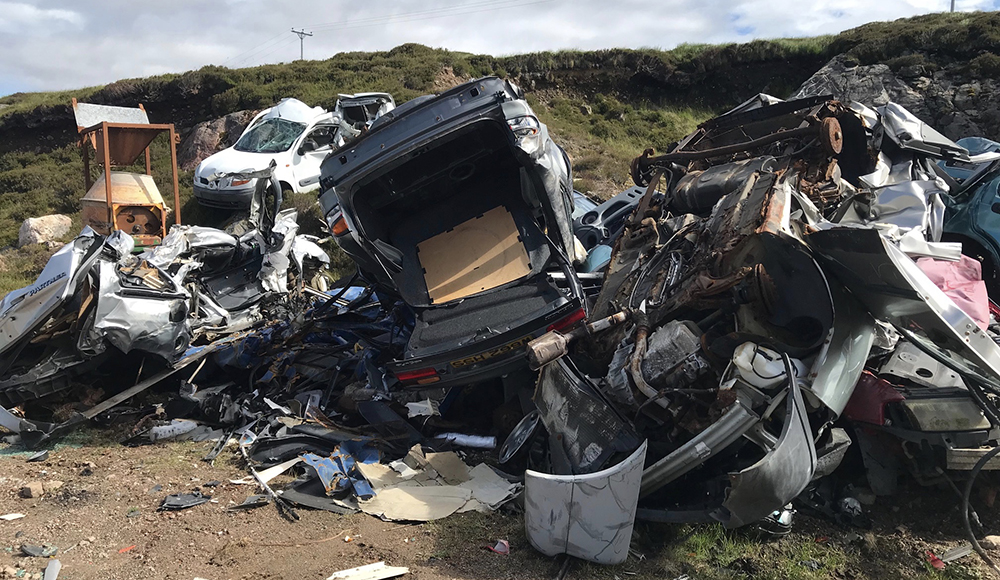
Rusty McCrushem’s Car Mash 5

It’s difficult to imagine how this obliteration was achieved. I stand jaw-dropped in fascination. It is at once shocking and thrilling. The juxtaposition of highland scenery and motorway pile-up is difficult to accommodate. Russian dissidents come to mind. A thoughtful and thought provoking addition is a rusting cement mixer. Is this another of Rusty’s wink to the laws of physics? The great mix? Eternal spinning of countless galactic particles? 
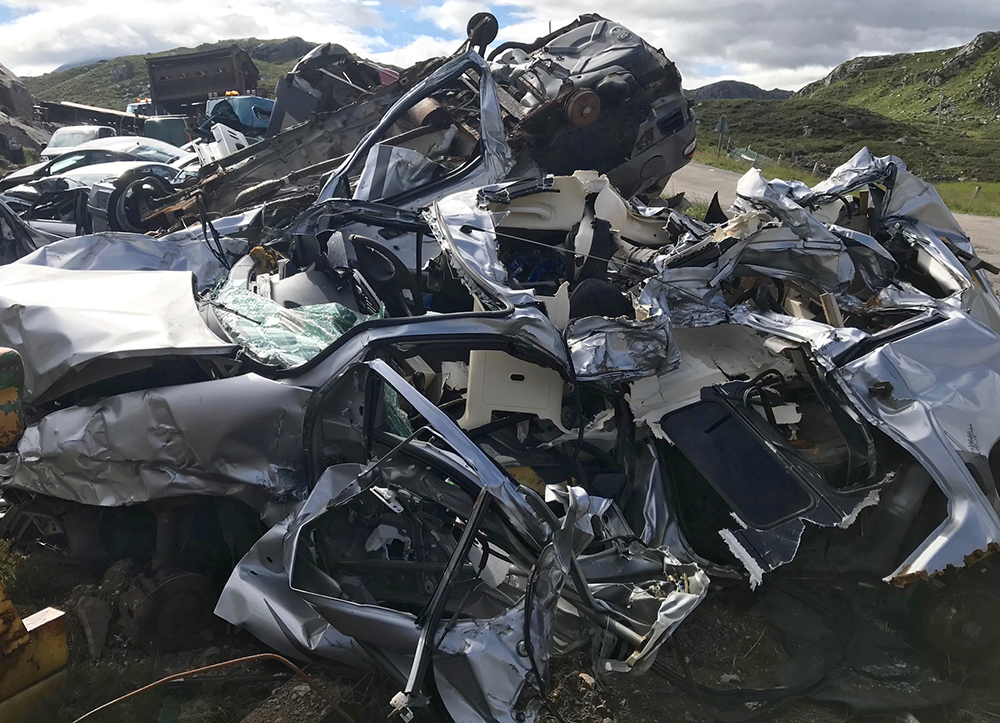
Rusty McCrushem’s Car Mash 6

Whatever one thinks of Rusty’s work, his genius for mashing large metal objects is awe-inspiring. I imagine him manipulating some great mechanical maw that chews up whole cars and spits them out on the roadside. He is shouting “This is art! This is art!” Is it?  Well, how else can he justify what he’s doing? Whatever, with this particular roadside wreckage, he has assured the enduring enigma of his oeuvre. 

Of an evening, as the northern sun settles, I am sure Rusty feels satisfied with his day’s work. I see his smug smile as he pours himself two fingers of his favourite tipple. Surely, the same two fingers that he waves at anyone – resident, tourist or environmentalist – bold enough to comment. Whatever emotions provoked by Rusty’s work, this whole gig just makes me angry. So there!
Jardin de la Bécassine

Isaac has come across some beautiful stuff that has a really unusual story. Quite by chance, he came across some guys who, in the middle of the pandemic, decided to restore a dilapidated public garden in Versoix, just outside Geneva. Using video, archival research and drone footage, he has documented the heart-warming renovation of the Jardin de la Bécassine.

Julien Spiewak and the Unkown Masterpiece

Julien Spiewak is young, talented, inspired and modest. His photographic oeuvre has been exhibited at art fairs in Rome, Rio, Seoul, Amsterdam and, significantly, Paris. I meet him at the tenth anniversary of that where-things-happen gallery, Espace L.  

Julien Spiewak and the Unkown Masterpiece 1
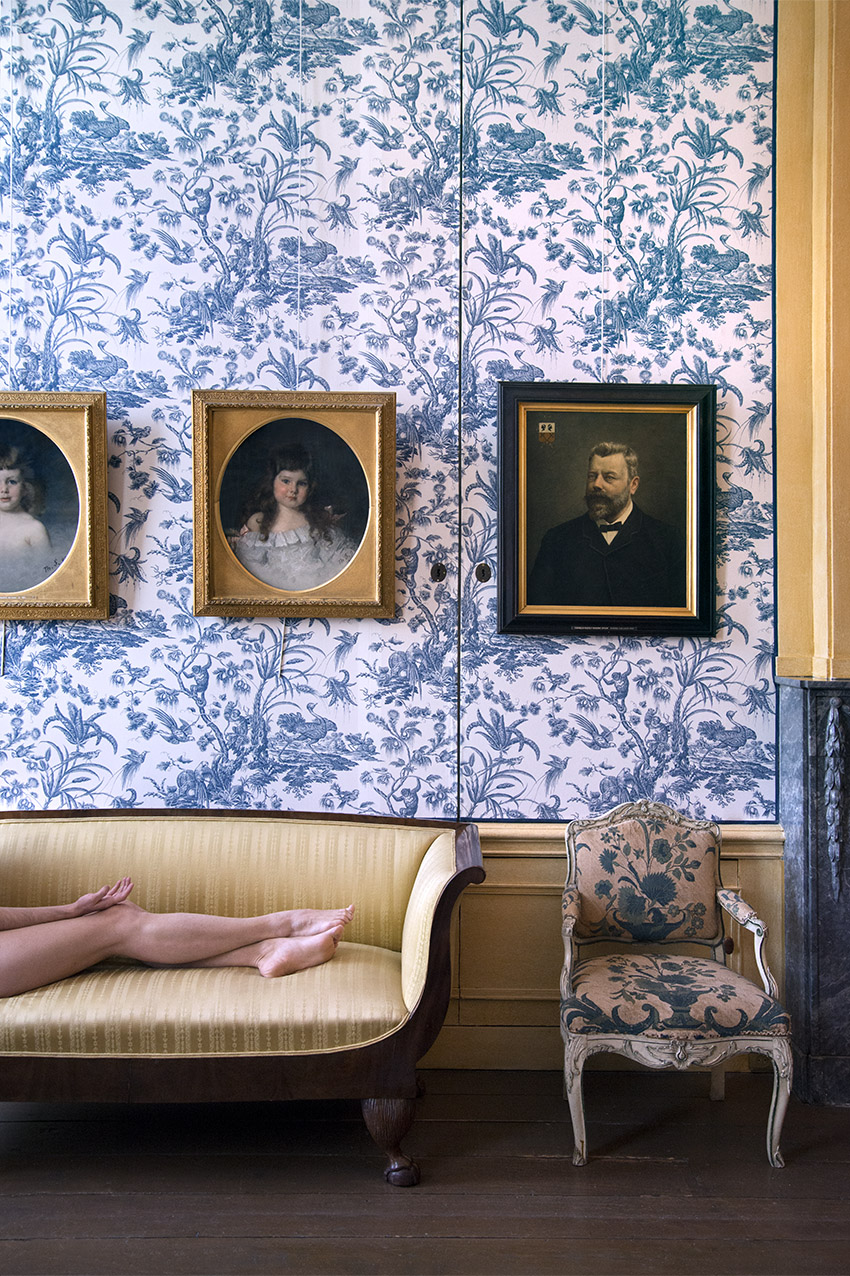
Canapé Biedermeier (XIXesiècle), portrait de Louis Marguerite van Loon par Thérèse Schwartze (1894), Juliette, fauteuil Louis XV (1750). Musée Van Loon. 2018

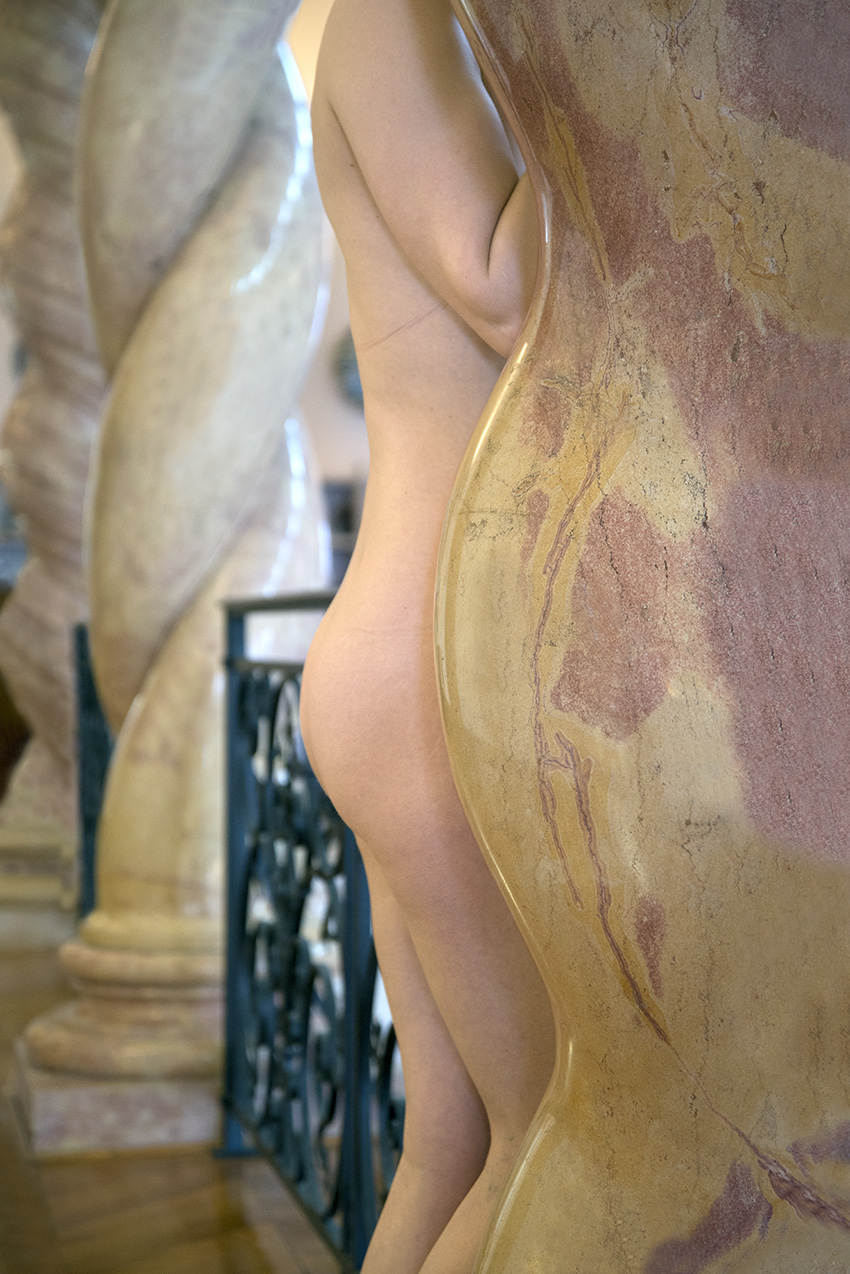
Julien took a degree in photography from the University of Paris in 2008. Since, he has with single-minded passion driven one project to considerable success: his Corps du Style (the title being a nod to the Louis XV Style.) His modus operandi comprises an intriguingly staged photograph in which only a part of his or a model’s naked body is set against furniture, painting or sculpture in the sumptuous surroundings of major museums. (Apparently, having access to an empty museum for this exercise is no mean administrative feat!) The resulting images are technically accomplished. Real beautiful stuff! At the same time, there is something a little disconcerting and even amusing in Julien’s striking contrasts between the living body part and the inanimate; the young and the old; the warm and the cold. I can’t help noticing how the rather discrete lines left by the young model’s bra play off the marble’s delicate veins. 

Julien Spiewak and the Unkown Masterpiece 2
Colonne de marbre, Carole. Musée Ariana, Ville de Genève. 2018

So far so good. Close co-operation with Espace L took Julien’s work to the Paris Art Fair in 2020. The Director of the Maison de Balzac tapped him on the shoulder, declared an admiration for his project and invited him for tea so to speak. “Have you read D’Honoré de Balzac’s Le Chef-d’Oeuvre Inconnu (Unkown Masterpiece)?” asked the Director. Julien had not… but he did soon after. Balzac’s short story, set in Paris and published in 1831, centres on the tortured soul of  a painter called Frenhofer, an old master of the day. Frenhofer tries to execute a masterpiece on canvas but ends up with a chaos of colour and swirls with a protruding human foot. Reading Le Chef-d’Oeuvre Inconnu was to be a major light-bulb moment in Julien’s life because, here in Balzac’s words, were countless phrases that seemed to speak directly to his Corps de Style photographed over the preceding years.

Julien Spiewak and the Unkown Masterpiece 3
Portrait d’Honoré de Balzac en plâtre patiné de Pierre-Eugène-Émile Hébert (1877), Julien. Maison de Balzac. 2020

Serendipity having added a new dimension to his project, Julien then set about doing his thing at the Maison de Balzac. He was also gifted a facsimile of the first edition of Le Chef-d’Oeuvre Inconnu. It’s pages with Julien’s annotations linking his photographs with Balzac’s prose are also on show at Espace L. But the story doesn’t stop there. Enter Leticia – the “L” of Espace L – who, in a former life, was a journalist and publisher. She figured that publishing a book that documents the entirety of Julien’s story and presenting the book together with some of his photographs would make a fitting event to celebrate her ten years in contemporary art in Geneva. She figured right!

Julien Spiewak and the Unkown Masterpiece 4
Photo: Talking Beautiful Stuff

Dominique Baqué, a prominent historian of photography, has written the book’s monumental and detailed foreword that reads like an “A” graded academic treatise. She concludes that the real, living, breathing Julien Spiewak represents the incarnation of the fictional Frenhofer. Wow! If she claimed that Julien’s image-making embodies the spirit of Frenhofer, I would readily agree. However, Frehhofer’s spirit is known to live on in real paintings. Paul Cézanne strongly identified with Frenhofer and went so far as to declare “I am Frenhofer!” None other than Pablo Picasso was commissioned to illustrate Le Chef-d’Oeuvre Inconnu. He moved his studio close to a where Balzac’s story unfolded and, during World War II, painted his own very well known masterpiece, Guernica.

As I leave Espace L, I ask Julien what he will be doing in ten year’s time. Without hesitation, he answers “Just this….” I think to myself, I can believe it and by then you will have collected the highest accolades in the world of contemporary photography.