About Robin

Occasional painter. Golfer. Fascinated by humanity. Passionate about beautiful stuff, the people who create it and its narrative.

Emrys Parry at Mandell’s Gallery, Norwich

Norwich. My home town. There are places here that carry enduring attraction. The castle. The cathedral. Elm Hill. Mandell’s Gallery. They’re all a long way from the spiritual home of Emrys Parry in Northern Wales.
Emrys Parry 1
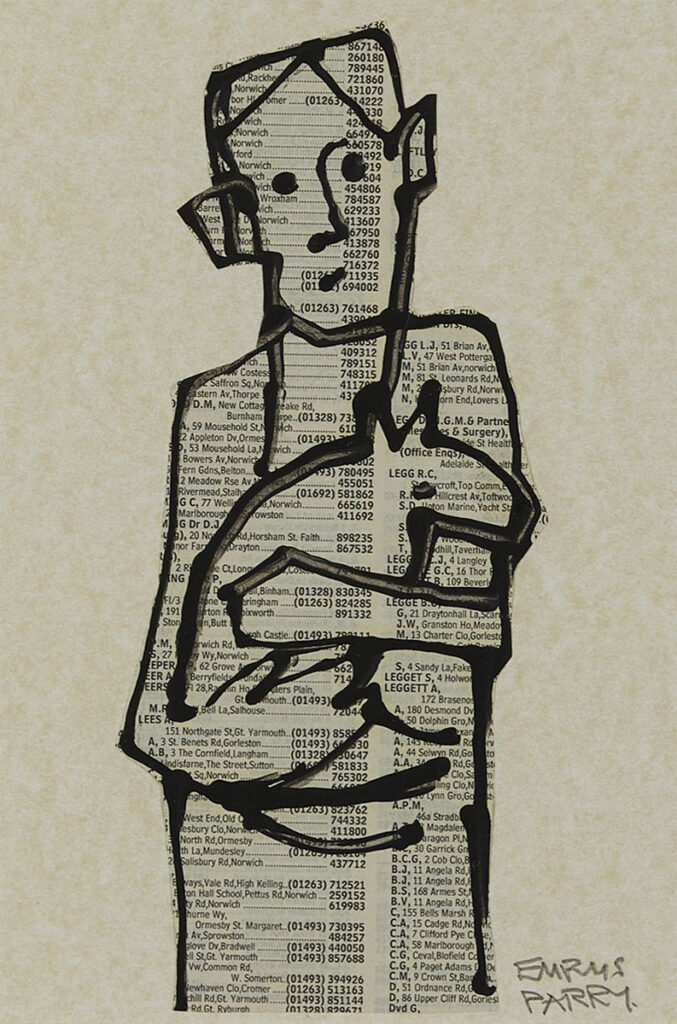
Emrys Parry “Man with dog” Mixed media 20cm x 12cm.

The first of Parry’s images that draws me in is deceptively simple. A man – a little worried and looking directly at the viewer – holds a dog in both arms. The lines are economically and elegantly painted on and cut out from a page of a Norwich telephone directory. The numbers make a digital column that runs down through both man and dog giving the impression that they are so close that their DNA is shared. I find this small picture at once touching, intriguing and satisfying.
Emrys Parry 2
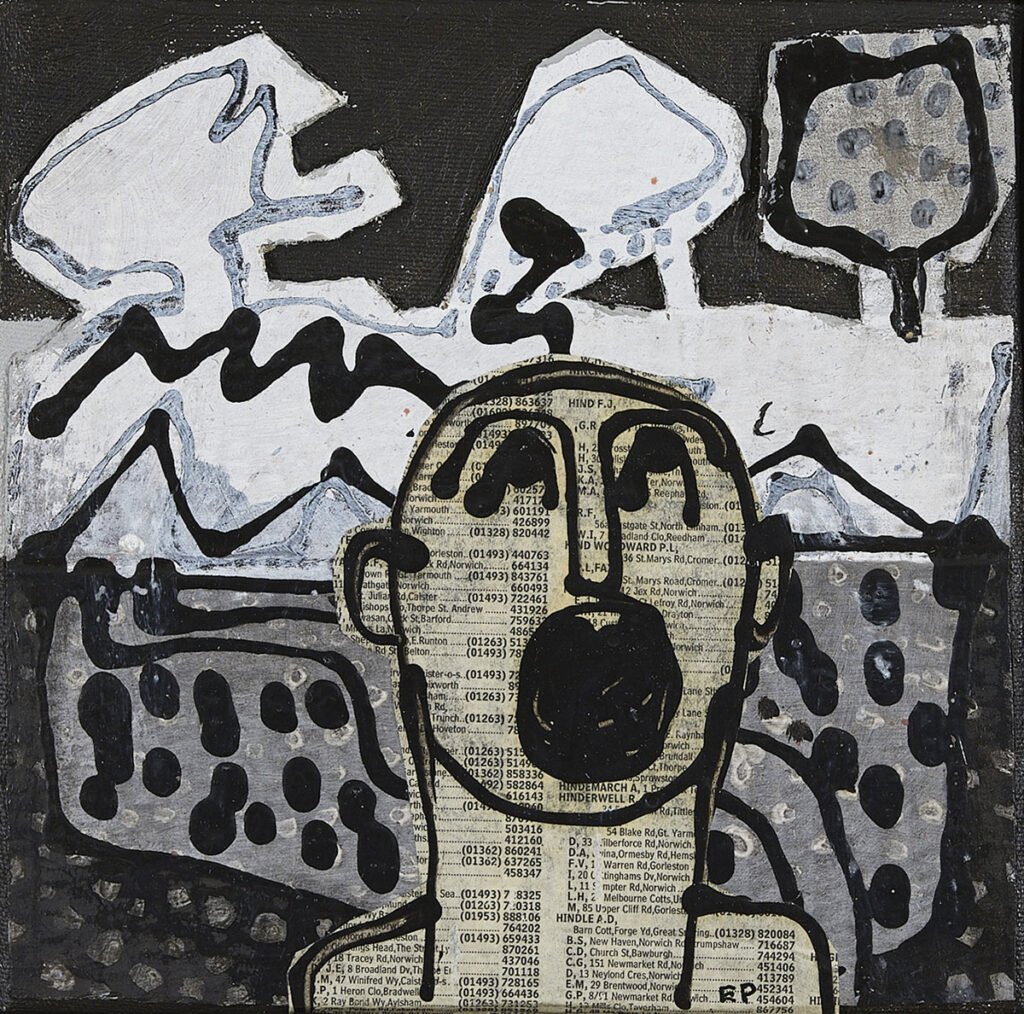
Emrys Parry “Land of my fathers” Mixed media 25cm x 25cm.

Another telephone-directory-man sings looking heavenward. The background is a stylised landscape comprising trees, a winding road and three mountains.

I learn that Parry left Wales in 1959 at the age of 17 to study Art and Design in Leicester. In 1963, he began a Norfolk-based teaching career at the Great Yarmouth School of Art and Design. However, he admits he has never severed the umbilical cord of his Welsh upbringing and the land of his fathers: the three-peaked Llyn Peninsula.
Emrys Parry 3
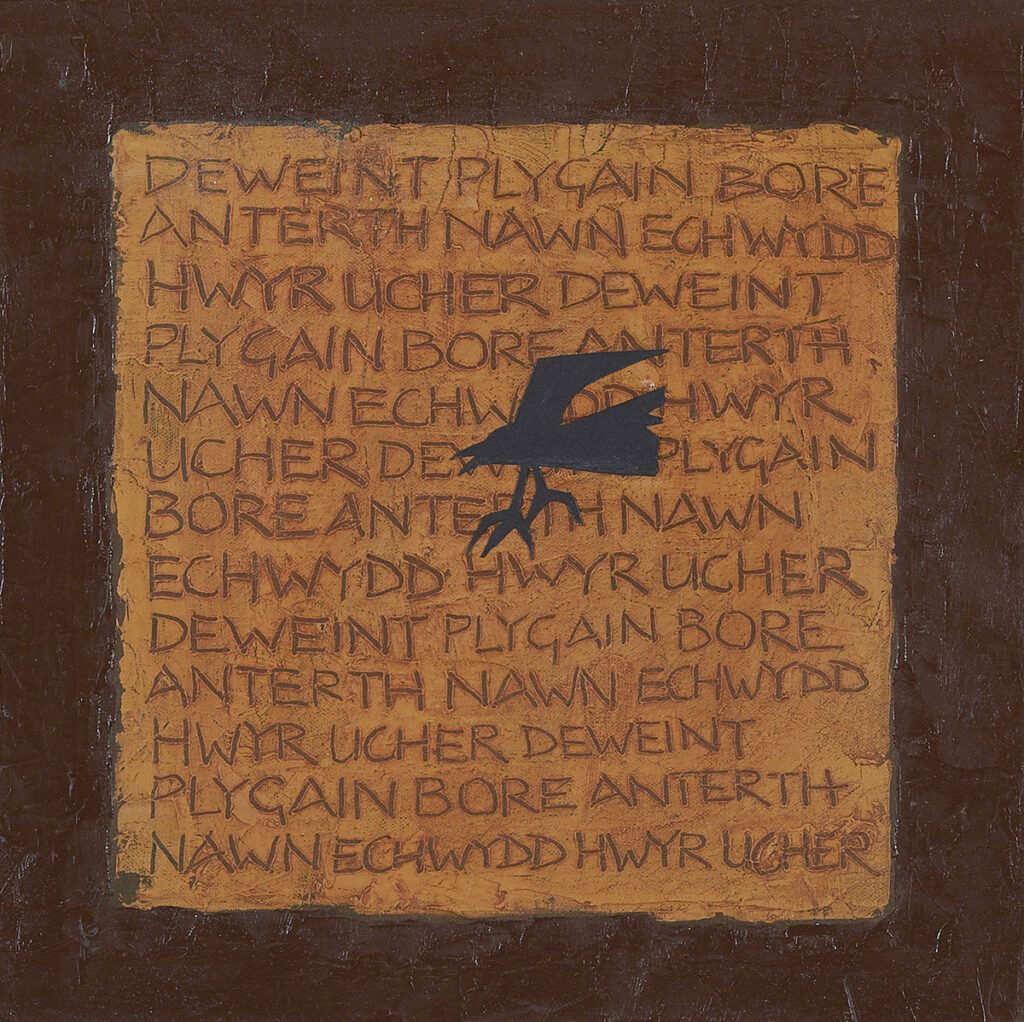
Emrys Parry “Black bird with script” Oil on canvas 50cm x 50cm.

Parry’s recent work relies less on observation and more on memory, myth and story-telling; it reflects a longing for his roots and a concern for the survival of Welsh culture. The Welsh language names eight three-hour intervals of a day. These eight words are found in many of his pictures. I wonder if the swooping black crow of time is, little-by-little, stealing away these words forever.
Emrys Parry 4
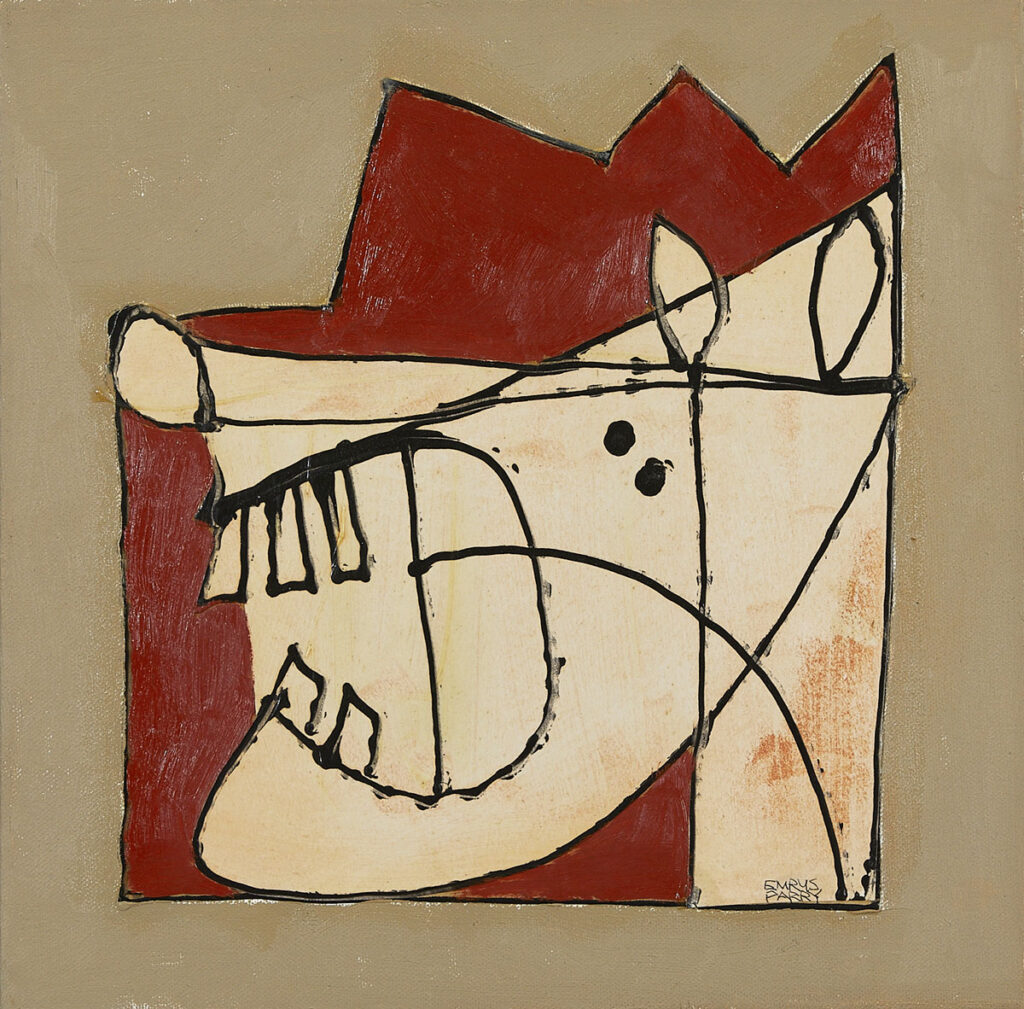
Emrys Parry “Frightened horse” Oil on Canvas 40cm x 40cm.

I am enjoying Parry’s beautiful stuff enormously. Here, his wonderful nearly-abstract-frightened-horse-nod-to-cubism is within neighing distance of the three Llyn Peninsula peaks.
Emrys Parry 5
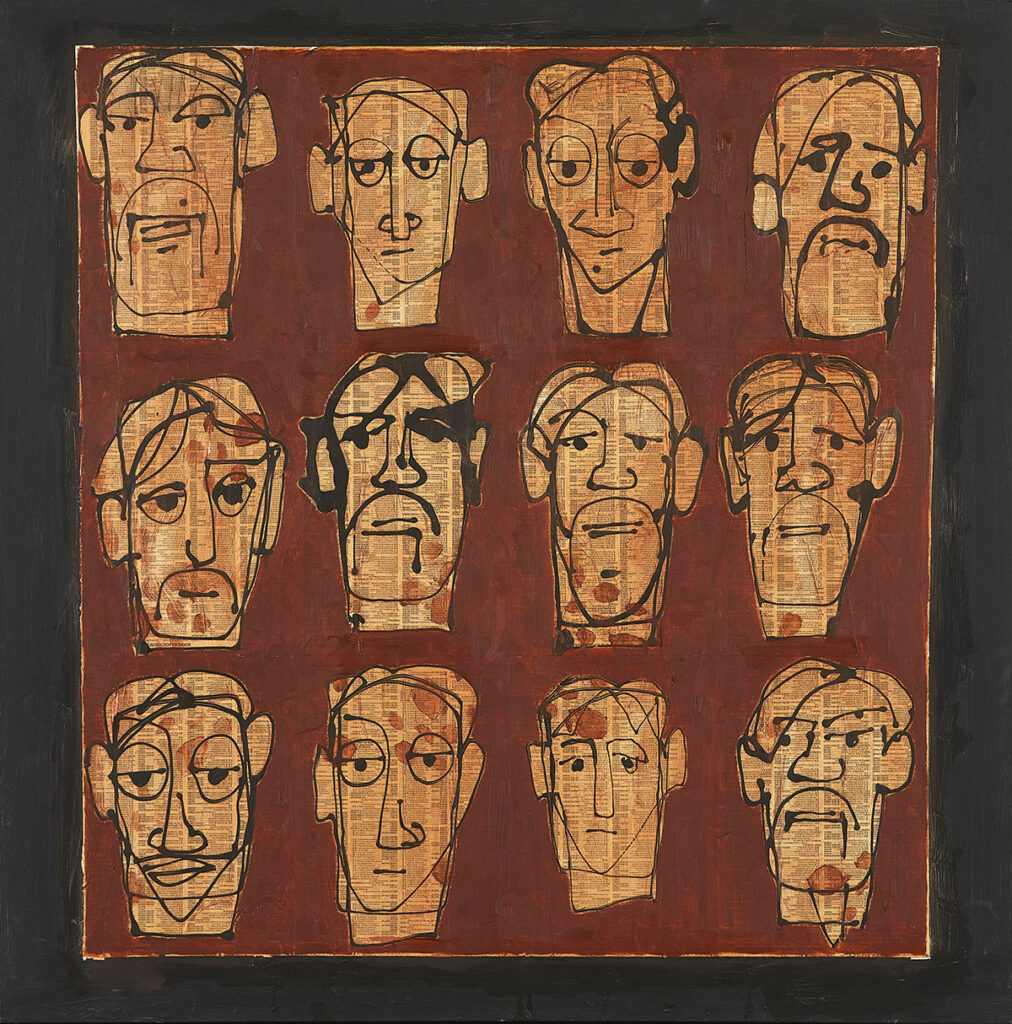
Emrys Parry “Twelve heads” Mixed media on canvas 100cm x 100cm.

The work that I really fall for has pride of place in Mandell’s. Twelve telephone-directory faces are painted in Parry’s signature dashed-cartoon style. Each man stares through me with intensity. Each seems like a good bloke. Is this a Welsh all- male choir? Welsh apostles? Twelve solid Welsh working men? A Welsh rugby team (minus the back row)? Whatever their purpose, these men are clearly united.

The ever-welcoming director of Mandell’s, Rachel Allen, deserves praise for this stylish exhibition. Each work has been beautifully framed and presented including a display of Parry’s exquisite sketchbooks and diaries.

Unfortunately, I don’t get to meet Emrys Parry himself. The most telling part of his bio reads “I am interested in the imprint of man on his environment and how past thoughts and actions of individuals are recorded and transmitted by the objects they leave behind. I believe that things created with love have a memory and warmth which is accessible to those who seek it for all time.” Evidently, he also is a good bloke. But I know that anyway; he taught my brother, Garth, how to draw!
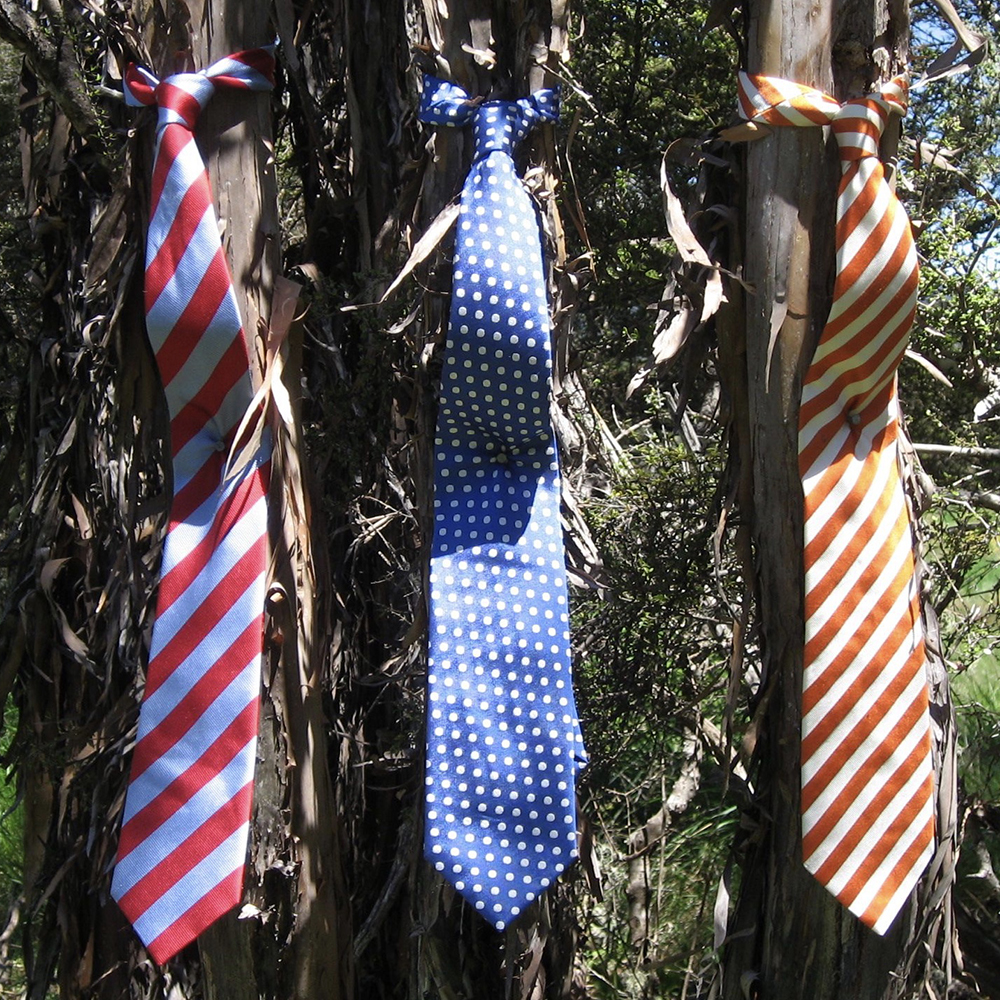
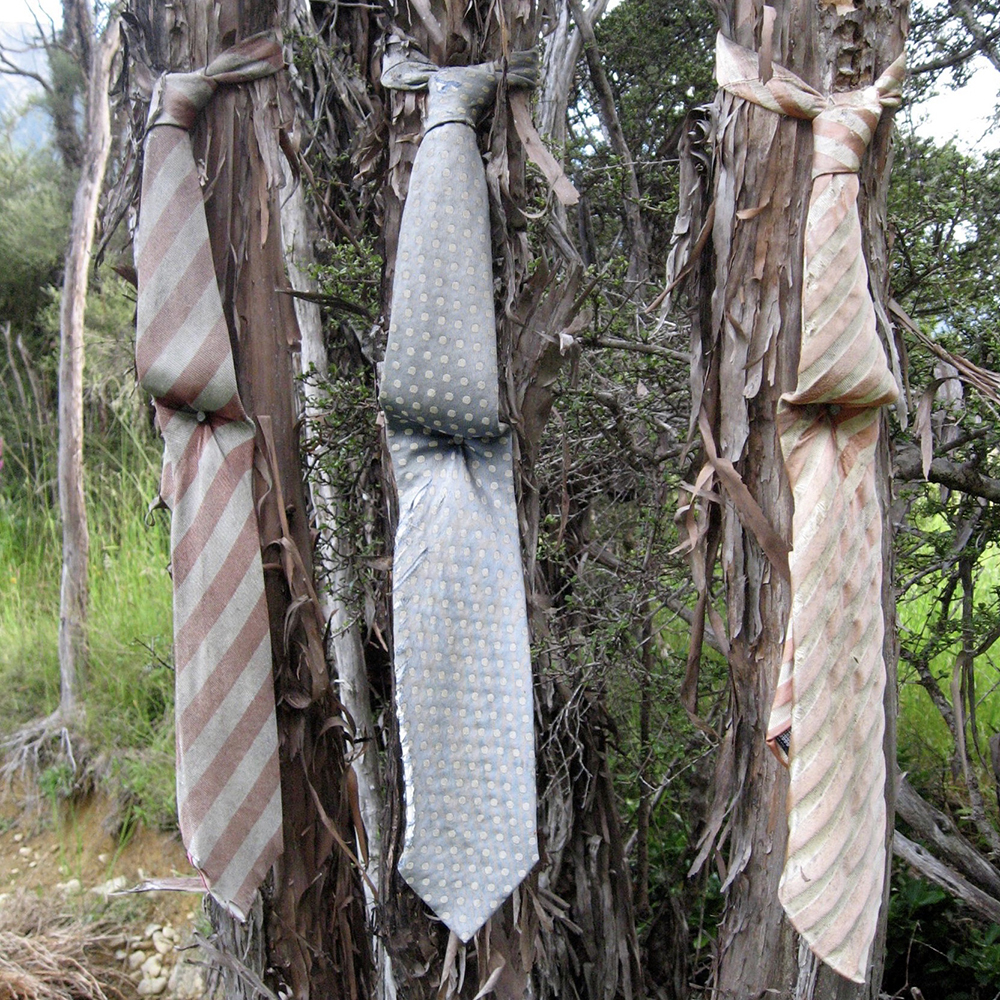
Manuka tie decay in New Zealand

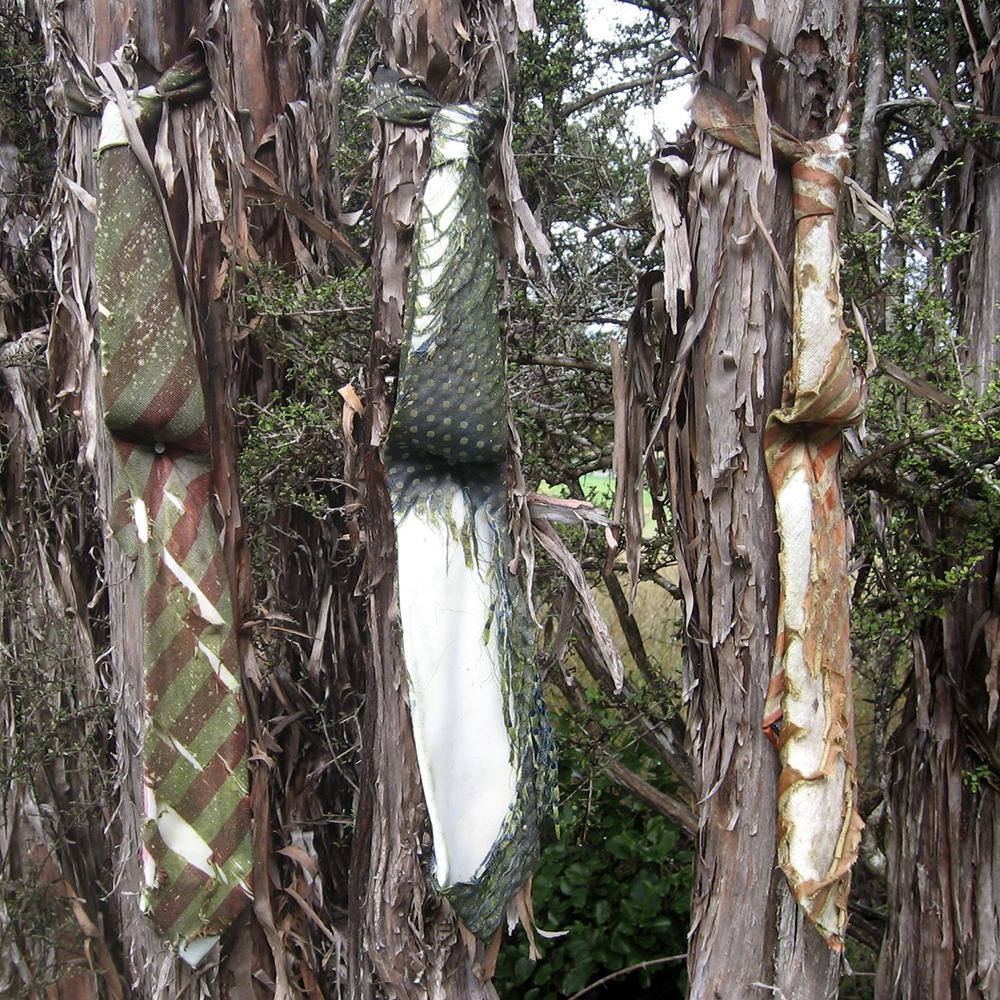
It is 2009. I am on a long, long flight. Needing to fill out an application for a visitor’s visa, I dig into my hand-luggage for a pen. I smile at what else I have brought with me. Carefully folded are three high-quality silk ties given to me by a friend who, on his retirement, swore he would never wear one again. I told him what I planned to do with them. He beamed.

Tie 1

I am lured back to New Zealand every year by the prospect of casting a dry fly over trout of memorable size in rivers of unforgettable beauty. This year takes me to the banks of a little-known creek off the Waikikamukau river. The creek is home to tiny trout that dart for cover as I approach. Only in the winter spawning season will the massive pink mama trout make their way up from the lake to await that brief and critical tail-flickering encounter with a hook-jawed male. However, I am not here for the trout. I am here for the manuka forest through which the creek tumbles. I want to install the ties and seek three trees of neck-size girth standing together.

Tie 2

In 2012, I pull on my hiking boots and return to my chosen manukas. I am amused by the way my carefully knotted ties with the naily tie-pins have maintained their business-like form but look like they have done way too many business trips. I wonder where this idea will go in the coming years.

Tie 3

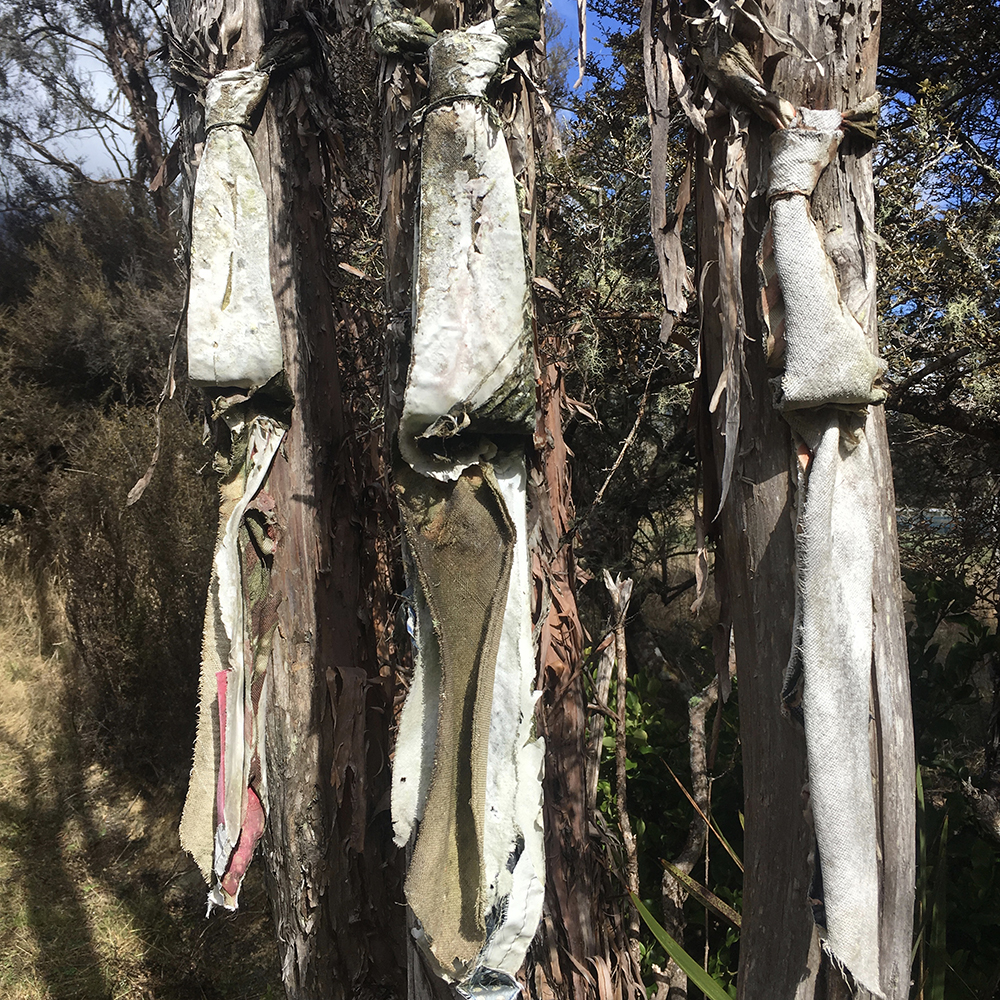
2016 finds me back at the creek. I am always fascinated by decay of man-made things but my little project in entropy seems to be a bit of a flop. Let’s be honest, the whole thing looks like what it is: three ties rotting on tree trunks. I have a sneaking feeling that Andy Goldsworthy is watching over my shoulder with a wry smile.

Tie 4

It is 2019. The ties are now gorgeously decayed. Their strut has long gone. They are almost at one with the flakey manuka bark and so are becoming part of nature. Time is the “artist.” I like what I see.

I try to recall why I did this in the first place. It was something to do with my anger about the bank-induced financial crisis of 2008. Why the tie thing? A tie…. That symbol of the powerful smart man. That totally unlikely, brightly coloured, pants-pointing neck-wear. I realise that my anger is now redirected towards the Trumps, Putins and Johnsons of the world. Maybe my exposed tie experiment conjures up more than macho-corporate decay; perhaps it speaks to our daily-growing awareness of that biggest of human trade-offs: on one hand, we have our booming population living life-styles that are driven by manufacturing economies that in turn are driven by the business and political worlds (both lorded over by tie-bearing men.) On the other hand, we have our inevitable, massive and global impact on the environment. Whatever path humans take, nature will win in the end. Big mama trout will swim upstream to spawn long after us clever and exotically dressed hominids have been consigned to the archives of the planet’s natural history. I admit to finding comfort in this.

The Standing Stones of Callanish, Isle of Lewis

The Standing Stones of Callanish 1

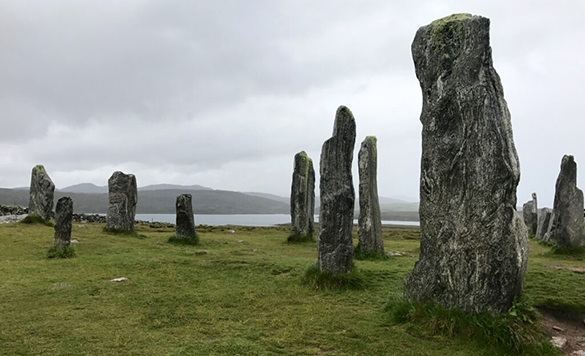
I am reunited with a long-lost Hebridean cousin. She suggests that, despite the weather, we visit some nearby standing stones. On the road to Callanish, the suggestion becomes less appealing as the wind speed rises, the temperature drops and the rain becomes horizontal. We pass bus shelters huddle-full of drenched and exhausted cyclists. At the well-organised visitor centre, the cafe is hung about with cagools and anoraks all dripping on the floor; their owners dawdle in the very informative exhibition wondering whether to brave what has to be the worst of Scottish weather. Cousin Rona can’t see what the fuss is about. During a brief pause in the downpour, she grabs my arm and force-wades me up the path to a series of crudely – if at all – hewn monoliths. It is bleak all around. We lean into the wind trying to orientate ourselves. Photography is near-impossible. But then no photograph conveys the massive, raw, resilient beauty of this 5,000 year-old collection of standing stones. Something here nudges my soul. I am surprisingly moved. Did our ancestors pass here? What did they do when the weather was like this? Then I think of the making of this place. These pillars of Lewisian gneiss weigh up to 50 tonnes. Did stone-age (wo)man split the stones and, if so, by what method? How were they brought here, positioned and placed upright? How long did it take? What role did the immense task and its outcome play in neolithic life?

The Standing Stones of Callanish 2
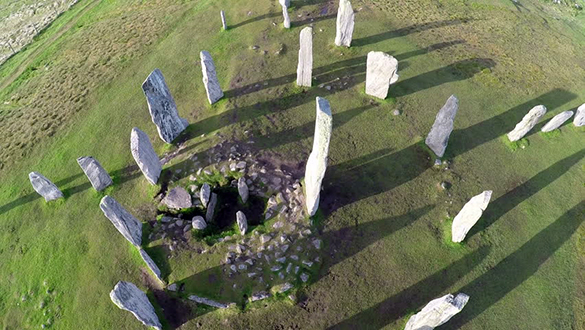
Aerial view of the central ring of the Callanish stones. Copyright: Shutterstock

The whole consists of a centre stone within a circle with lines of other stones radiating out to the south, east and west. There is a longer “avenue” or double line of stones to the north. There is also an exposed chamber just east of the central stone; it is thought this might have been built later for ritual or habitation or both.

This particular collection of standing stones is just one of eight in the Callanish area. It is one of the oldest of more than one hundred such sites found across Scotland. What is so intriguing is that these not-so-primitive people must have had a very important reason to expend so much time and energy in the construction of these sites. Information on display at Callanish and on-line makes evident that nobody has a clear idea about what was in these people’s minds. It seems likely that there is a religious importance and these were places of ritual. It is claimed that different sites have similar alignments with the paths of the sun and moon. Were these earliest Hebrideans trying to make sense of how the movements of the sun and the moon change throughout the year so cementing in their culture notions of night versus day, dark versus light, cold versus warm and winter versus summer? Or is it as simple as respect for the dead? Life then would not have been as super-sanitised as our’s today; we have virtually no contact with dead bodies and recoil when we do. Were these sites some kind of welcoming gateway to an imagined after-life where the dead would begin their onward journey? I can’t help feeling that the importance of answering these question goes beyond the academic. One thing is clear: the question of “why” comes down to humans’ universal capacity to believe in something abstract and the power of such belief when held in common with others. These magnificent standing stones therefore must represent an essential element of humanity.

The Standing Stones of Callanish 3
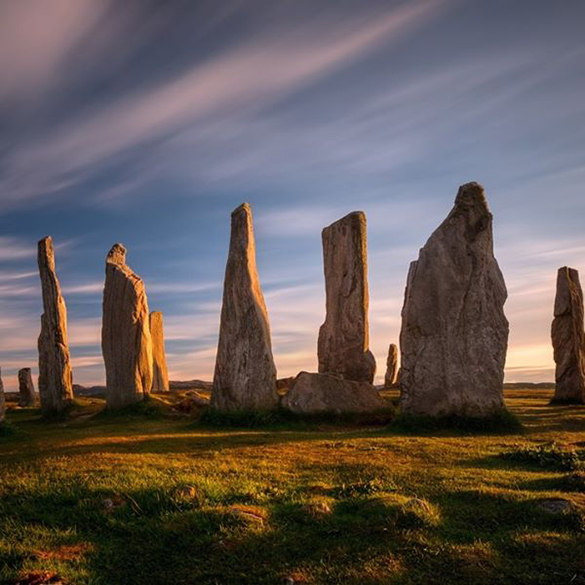
The central ring of the Callanish standing stones. Copyright: Visit Outer Hebrides

Later, by a warm peat fire with a cup of tea, I find a picture on-line that tells me that blue skies do happen here. My desire to return, however, is not fired by hope of fine weather; something calls me from way back in time.