About Robin

Occasional painter. Golfer. Fascinated by humanity. Passionate about beautiful stuff, the people who create it and its narrative.

Celebrity Beautiful Stuff

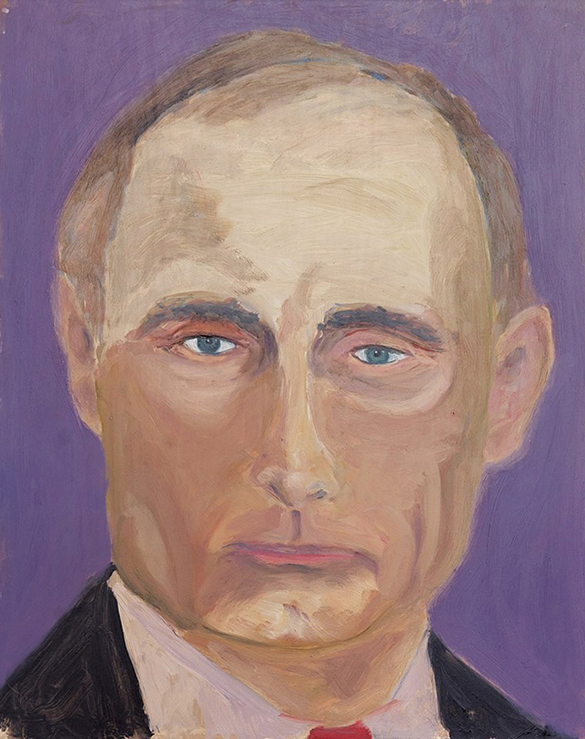
George W Bush said of his Russian counterpart “Vladimir Putin is a man I could do business with.” Despite its sixth-form style, I’m sure this portrait captures the real sentiments of most world leaders: “I am not sure I want to do business with Vladimir Putin, but I don’t have a lot of choice!”
Celebrity 1

“Vladimir Putin” by George W Bush 2013, 35cm x 25cm, Medium unknown. Copyright: Art of Leadership, Dallas, Bush Foundation

This painting was, in fact, done by George W Bush. If I am allowed an opinion, I think the Putin portrait reveals what the painter felt about the subject: a mixture of fear and respect. This possibly insightful work is the most interesting part of the former US President’s “Art of Leadership” exhibition in which he lavishly displays his own portraits of world leaders (and his dog.) But are they good? Do they have some additional “artistic” merit because of their provenance? Would they demand a higher price than exactly the same work done by, for example, a not terribly talented art student? You bet they would!
Celebrity 2

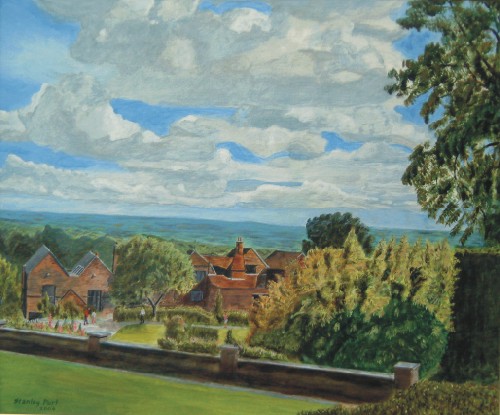
“View over Chartwell” by Winston Churchill (year unkown) 50cm x 41cm, Oil on canvas.

The notion that “W” was powerful leader and painter, brought to mind a visit to the Royal Academy in London a few years ago. I saw – and admit to being not too impressed by – a room full of paintings by Winston Churchill. Recently, a different landscape of his Chartwell home sold at Sotheby‘s for £1 million. So let’s ask another question. If the painter has or had the power to change the destiny of the world, does the picture have additional value because of who painted it? You bet it does! But this is not just about powerful leaders. What it comes down to is our fascination with celebrity.

A few weeks ago, I was in Guildford’s chic and cheerful high street. The stylish Forest Gallery seemed like a good place to flush out some beautiful stuff. And so it proved to be; I found celebrity beautiful stuff! One wall had signed limited-edition prints by Ronnie Wood, Bob Dylan, and Billy Connolly. The gallery’s owner, Washington Green, specialises in works by these celebrities.

Celebrity 3

“Rhino” by Ronnie Wood 2005, 62cm x 47cm Screenprint. Copyright: Ronnie Wood Gallery

Rolling Stone, Ronnie Wood, went to Ealing Art School. He kept on painting throughout his whole rocking career. I love this dozy “Rhino” screenprint. However, most of his paintings feature members of the legendary band. The Forest Gallery also had a stunning original of Sir Mick Jagger in action. Would I want a Ronnie Wood print on my wall? Maybe, if I could afford it. Would I want to own an original and show my friends? You bet I would!
Celebrity 4

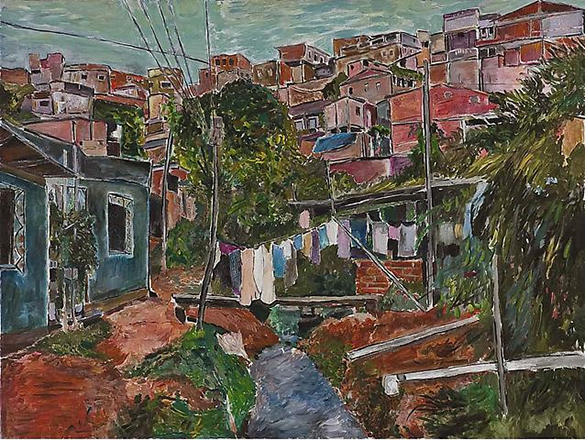
“Favela Villa Broncos” by Bob Dylan 2009, 107cm x 142cm Acrylic on canvas. Copyright: Gargosian Gallery

Despite the enduring presence of Bob Dylan’s music throughout my life and having enjoyed his tangled autobiography “Chronicles,” I never knew he sketched and painted and has done so for 40 years. “Favela Villa Broncos” is one of many ordinary scenes he favours. His “Drawn Blank” series painted between 1989 and 1992 is exhibited in New York and has caused a bit of a stir. But critics have used terms like “less-than-museum-level-artwork” and “art connoisseurs may question the quality.” Here’s my opinion: the man who has probably had the greatest influence on modern music (No Dylan, no Beatles!) has put paint on paper. The result resonates mysteriously with his music. In other words: THIS IS BOB DYLAN’S STUFF!  Whatever the New York art critics say, New York art collectors seem to agree and are prepared to pay up to $300,000 for one of his pieces.
Celebrity 5

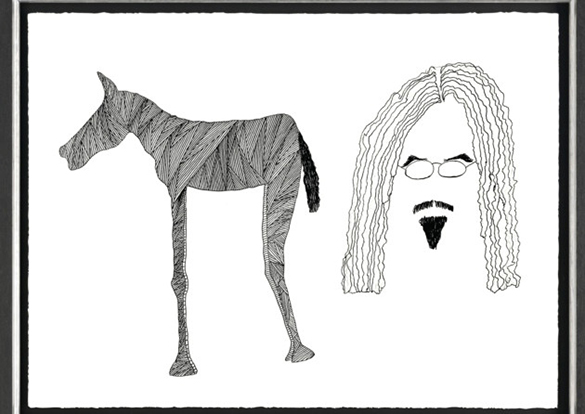
“Self Portrait with High Horse” by Billy Connolly 2011, 56cm x 51cm, Drawing print on watercolour paper. Copyright: Washington Green

Comedian, musician and film actor Billy Connolly has only very recently taken up drawing. Apparently, in 2007, he ducked into an arts supply store in Montreal to escape the rain. Buying pencils and paper seemed like a good idea. He initially hid his doodlings from view but they have since developed into an exhibited series “Born on a Rainy Day.” Beautiful stuff? I’m not sure. But I like them. They are simple but distinctive. There is something that speaks to the Big Yin’s cutting sense of humour. Bear in mind, he’s Glaswegian. Maybe his “Self Portrait with High Horse” is a memo to self – and others – about not getting on a high horse? The prints can be ordered on-line for £700 each.

Talking Beautiful Stuff is about the narrative behind the human impulse to create. We do not aim to comment on, let alone critique, the output of that process alone. The “who” is as important as the “what,” “when,” “where” and the “how” of beautiful stuff. And the “who” is especially important when it comes to celebrities. Let’s admit it!

Humans are fascinated by celebrity. This is part of our nature. Individuals of every culture and, importantly, every primate group are constantly alert to the doings of those who have superior authority, standing or prestige. Whether alphas, royals or warriors, it is these people that determine our security, access to resources and possibilities of greater prestige for ourselves. This hard-wired fascination extends to others with whom these important people are consorting. In this way, we get to understand the ebb and flow of important influences in our societies. Gossip is important; especially celebrity gossip. Hello! Paris Match! OK! If the focus of our fascination and gossip puts paint on canvas, we cannot divorce the painter from our consideration of the painting. Owning the canvas adds to our prestige. This is why we want it and why we are prepared to pay for it.

A judgement of the aesthetic merits of any work includes who the creator is. This is part of the work’s narrative and the difference between stuff and beautiful stuff. I am not shocked if a childish daub by Picasso sells for millions. It’s a Picasso! If I’m honest, I’d be really pleased to own – so I can show it to others and therefore boost my social standing – a childish daub by Barack Obama, Cristiano Ronaldo, Madonna or the Dalai Lama. And having made reference to humans as primates, I’d be happy to buy a work by Congo the Chimpanzee but, first, I would have to speak to my bank manager.
Robert Ramser’s Holy Creatures

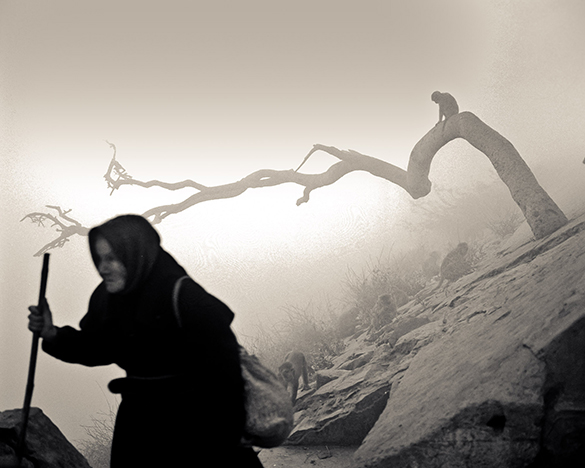
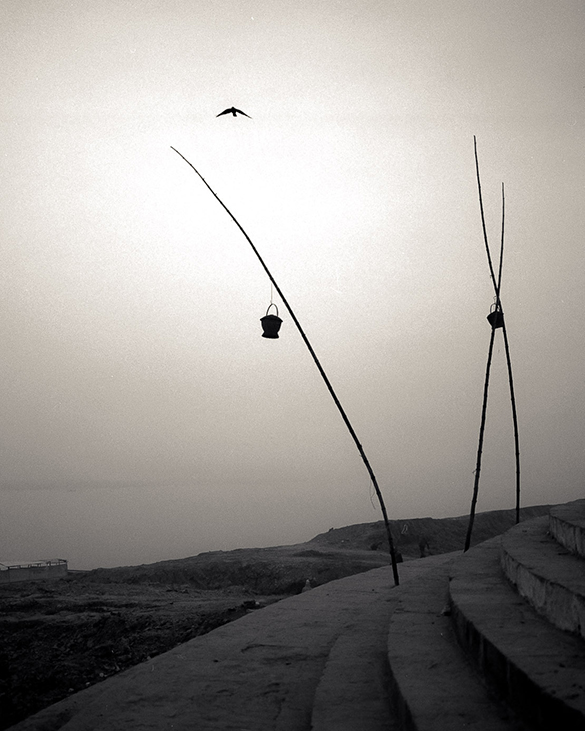
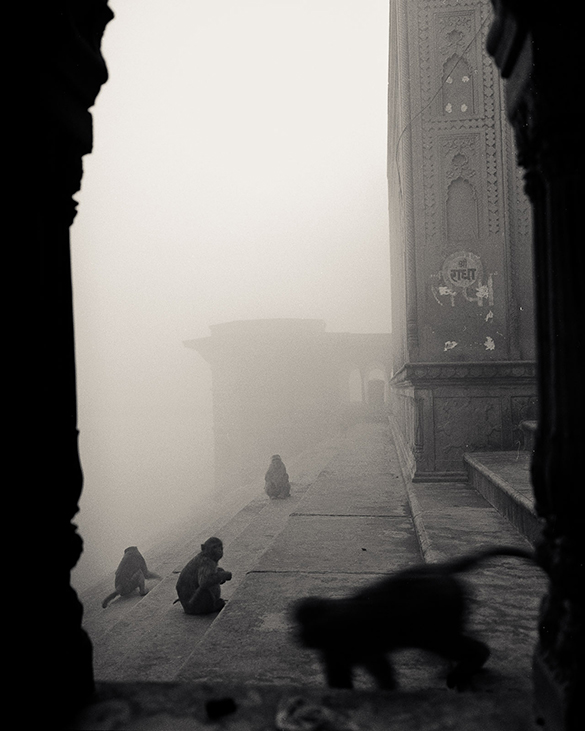
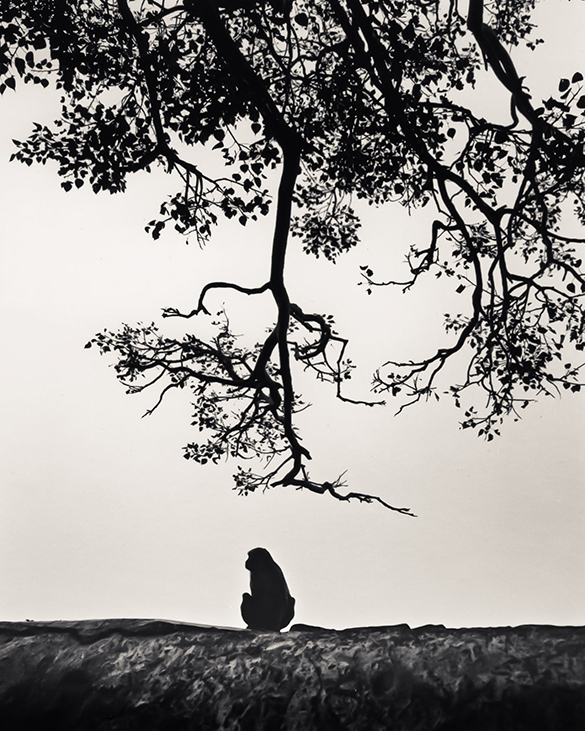
Calmly sipping a cup of Darjeeling tea, Robert Ramser told me his advice to any aspiring photographer. “Stay with your own style. It is better to take a bad photograph in your own style than a good photograph in someone else’s style.” In his series “Holy Creatures” – the subject of his up-coming exhibition – he certainly stays with his own style. But you will not find a bad photograph. They are all developed by hand from medium-format film. They are beautiful.

Ramser 10

The Philosopher, Vrindavan 2008

Last year, I met Robert at his home. I wrote about his mesmerising Asian photography. He told me that, on one of his photographic journeys to Mumbai, India, he became fascinated by the spiritual presence of animals. He had taken refuge from the heat in a small museum and discovered a series of miniature paintings illustrating the ancient Panchatantra fables from the Mogul era. He explained “In Hindu, Jain and Buddhist philosophies, every living thing is a soul incarnated in a material body. I was inspired by the exquisite manner these artists showed the presence and the dignity of the animals…”

Ramser 11

The Widow, Vrindavan 2008

Robert’s images are delicate and enduring. They have captured the animals’ indifference to humanity. I am sure that if I look for long enough, souls will appear! And there is atmosphere. I feel heat and humidity. I smell dust and open drains.

Ramser 12

The Lights of Paradise, Varanasi 2013

Ramser 13

The Capuchin in the Alcove, Vrindavan 2008

A hallmark of Robert’s Asian photography is that it is difficult to imagine the presence of a photographer in the scene. However, at 6.00pm on 5th June, Robert will definitely be present at the opening of “Holy Creatures” at the prestigious photo gallery Fotografika at 10, rue Borgeaud in Gland (between Geneva and Lausanne.) The exhibition lasts until 26th July. Go!

Old Tom’s Old Course, St Andrews

There is something spiritual here. This is hallowed ground. Even in April, the pilgrims are everywhere. Alone, in pairs and in small groups, they emerge on foot from the surrounding narrow grey streets. Some arrive by car and drive slowly along the beach front unable to keep their eyes on the road. Buses discharge them by the dozen. The reaction is the same the moment they first catch sight of that vast area of immaculate rolling green. Mouths gape open in surprise. Then a kind of dreamy smile takes over each face and out come the cameras. Great things have happened here. Hopes have come true; others have been crushed. Even though the wind blows, everybody speaks in hushed tones. You don’t have to hear the voices to know that the devotees come from every corner of the globe.

Old Tom 1

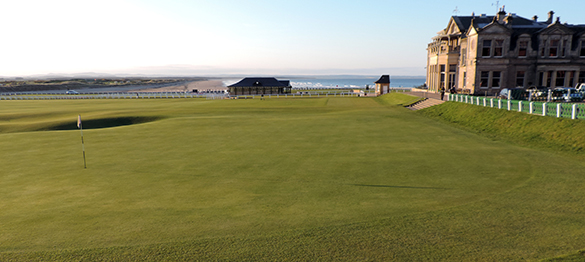
The 18th green of the Old Course at St. Andrews with – viewed from left to right – the “Chariots of Fire” beach, the Old Pavilion, the wee starters office and the Royal and Ancient Golf Club. (The lens shaped shadow just the other side of the flag is cast by the “Valley of Sin.”)

Every great golfer has walked this green mecca on the east coast of Scotland. Every golfer dreams of walking it. As I write, I hear the non-golfing reader groan. Surely Talking Beautiful Stuff is not going to describe a golf course as “beautiful”? Well…. yes! This blog is dedicated to the many and varied aspects of the human ability to design and create beautiful stuff. The Old Course at St. Andrews is a thing of beauty and not only because it’s the most famous golf course in the world. What also makes it beautiful is that it’s the mother of all modern courses. It is the original. It is unique. It is steeped in history and tradition. It is the home of golf and the Open Championship. After mother nature, the man to whom its creation – and the modern idea of golf – is attributed is Old Tom Morris.

Old Tom 2

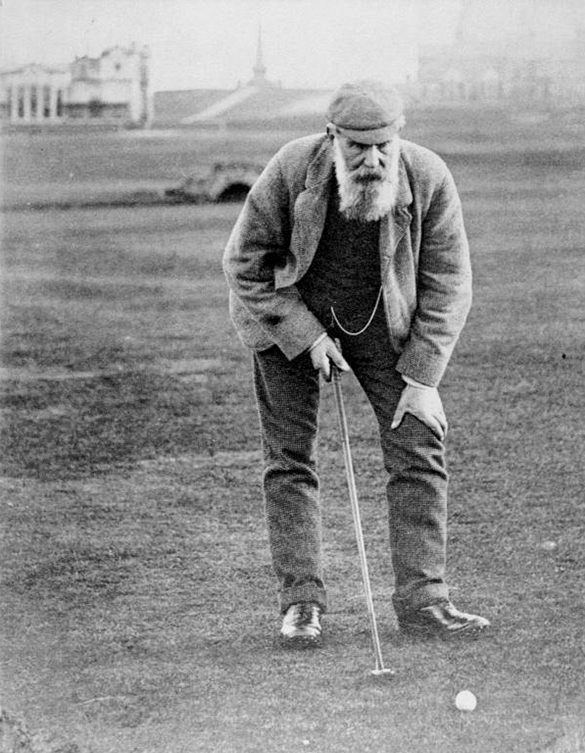
Old Tom Morris in 1905. Behind him is the Royal and Ancient Golf Club and the Swilcan Bridge. Photographer unknown.

It is known that golf – or something resembling it – and football were played on the St. Andrews links since the early fifteenth century. (At the time both pastimes were forbidden by Royal decree!)  It is also known that in 1764, there were 22 holes that were played in both directions. The four shortest holes were later combined into two making the now-standard 18 holes. In 1863, the Royal and Ancient Golf Club employed Thomas MItchell Morris Senior (1821 – 1908) to redesign the St. Andrews golf links. Old Tom found the links in a poor state. He set about fashioning the huge greens, widening the fairways and putting in the hundred or so bunkers. He also developed the ideas of dressing greens with sand to improve the quality of the grass and having a separate teeing ground for each hole.

Old Tom 3

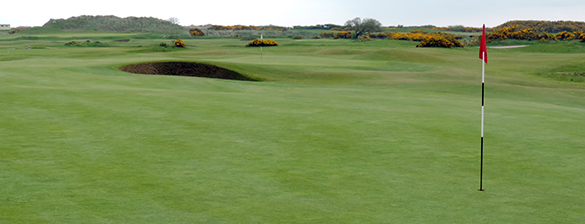
The massive double green shared by the 3rd (white flag) and 15th (red flag) holes with the Cartgate bunker.

Ask a grizzled Old Course caddy why there are eighteen holes you will most likely hear that there are 18 drams of whiskey in a whiskey bottle! The same caddy will cite Old Tom’s fascination with eighteen because the great double greens have been so laid out that the 2nd is paired with the 16th, the 3rd with the 15th, the 4th with the 14th and so on each pair adding up to 18. Whether this is by chance or a design masterstroke, we will never know. It leaves only four single greens: the 1st (“Burn”) enticing the ball of the unwary or unskilful golfer into the Swilcan burn, the 9th (“End” – where Old Tom seems to have had a small lapse of imagination,) the 17th “Road” of (in)famous bunker fame and the O so glorious 18th (“Tom Morris”) and its Valley of Sin.

Old Tom 4

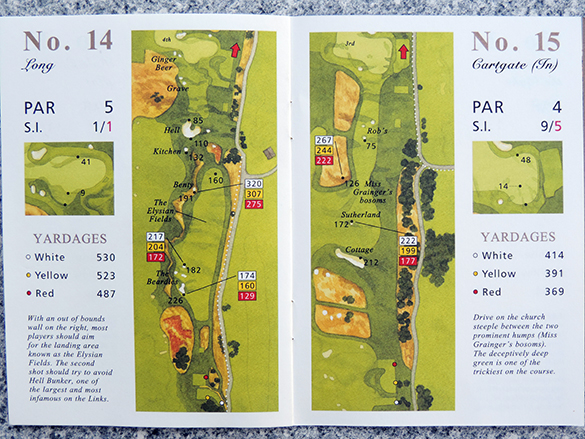
Holes 14 and 15 on the Old Course guide. Copyright: St Andrews links 2014, artwork by Lee Wybranski.

The stylish course guide for the visiting golfer shows just how full of quirks the Old Course is. Every hole, bunker or feature has a name. On the 14th hole (“Long”) you are advised to drive for the Elysian fields and at all costs, to avoid Hell Bunker. On the 15th hole (“Cartgate”) you have to pass over the Cottage and Sutherland bunkers aiming just left of Miss Granger’s bosoms. (And while we are on the Old Course’s lexicon, I was very happy that my drive on the 16th hole avoided the Principal’s Nose and, on the 18th hole,  bounced just beyond Granny Clarke’s Wynd!)

Many other courses bear Old Tom Morris’s name and character; they include Prestwick, Muirfield, Royal Dornoch, Royal North Devon and South Uist. However, he was much more than a course designer. He was a club maker, ball maker, green-keeper and, amazingly, a prestigious golfer winning the Open Championship no less than four times. What a guy!

Old Tom 5

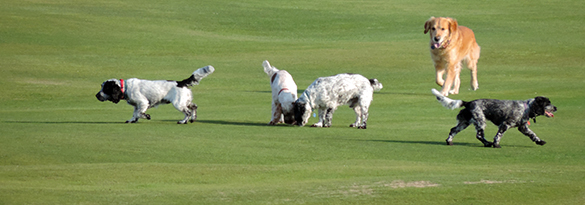
Sunday on the Old Course.

The most wonderful and unexpected part of the Old Course story is that it is still public land. Golf and its terrain do not have to be exclusive. International visitors are perplexed. I hear an American voice: “Excuse me, but can I really walk on the course? I mean, like, this is St. Andrews!” Not only is it public land but it is closed for play on Sundays. Anyone can stroll around and – wait for this – walk their dogs. This offers a stress-free opportunity to visit some of the notable features especially those to be avoided.

Old Tom 6

Hell Bunker on the 14th (“Long”) hole.

And if your name is drawn on the ballot to play the Old Course – another wonderfully democratic aspect of the St Andrews golf scene – you find yourself standing on the first tee, in front of the Royal and Ancient Club House with dozens of on-lookers, knees a-tremble, praying that you will get your first shot of the day away without embarrassing yourself. I did not embarrass myself but I couldn’t help feeling that some of the voices that mumbled “nice shot” came up from that ancient turf.

Whatever happens from then on in your round, my advice would be to simply enjoy it and don’t worry too much about how you score on those sacred holes. That is until the 18th. You are back in the historic arena. In your mind, the whole golfing world past and present is watching. From the tee, it looks like the widest fairway in the world. “Aim at the R&A clock” says the caddy, Ian. A few minutes later, I am approaching the most famous green in the world. My second shot, a firm wedge into the easterly wind, lands ten feet from the pin. A few casual observers hanging over the white boundary fence applaud half-heartedly. But I feel a little weak with relief. And we were just playing for beer! Without success, I try to imagine making that shot and one putt for £000,000s.

Afterlife or no, if you design or create something beautiful, some small part of your spirit lives on for the benefit of others. The Old Course at St Andrews, the traditions born here and the tens of thousands of golfers who visit each year are testament to the spirit of Old Tom Morris.  He lives on and in style.