About Robin

Occasional painter. Golfer. Fascinated by humanity. Passionate about beautiful stuff, the people who create it and its narrative.

Fear and loathing in…… Switzerland!

As I write this blog post a United States health official announces another ebola case in Texas. Fear. There is the first talk of a flight lock-down to and from West Africa. President Barack Obama says the risk of an outbreak of ebola in the United States is “extremely low.”
Swiss Political Posters 1

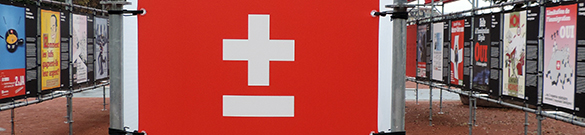
I hear there is an outdoor exhibition in Plainpalais organised by Geneva city council. It documents how the foreigner – read: immigrant, legal or illegal – has been depicted in Swiss political posters. It distracts me from this morning’s gloomy news. I am welcomed by a clever image playing on the Swiss flag and inequality. The posters dating back to the 1920s are both fascinating and alarming. I come to understand that a section of the Swiss political community consistently cultivates fear of the other with ingenious design concepts. This article is about the posters and how I see them as vehicles for political messages. As a general rule, I try not to express my own political views (even though I find some of the posters offensive!)
Swiss Political Posters 2

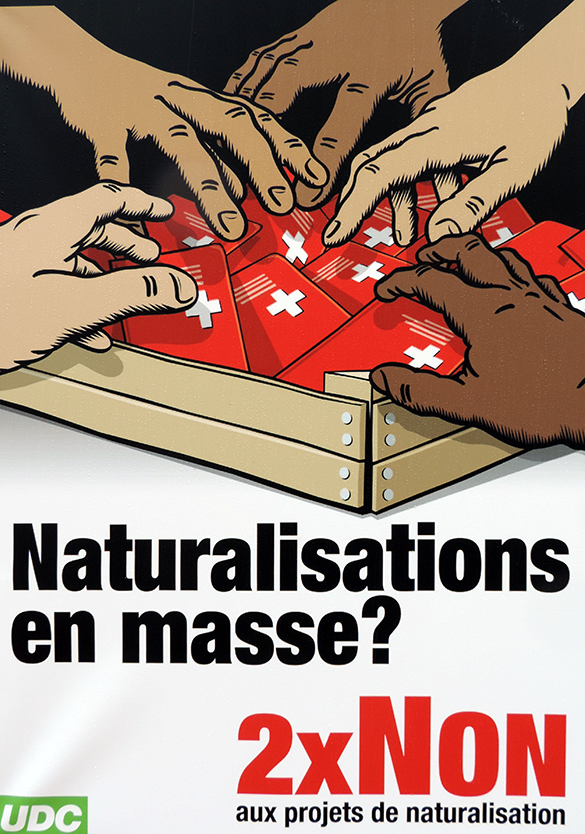
The principal means of depicting unwelcome foreigners is by indicating their darker skin. According to this 2007 poster, the worst case is that they might en masse gain Swiss citizenship. The designer here has created a notion of multi-racial greedy-grabbing of those all-too-accessible Swiss passports. The darkest hand is particularly clawing.
Swiss Political Posters 3

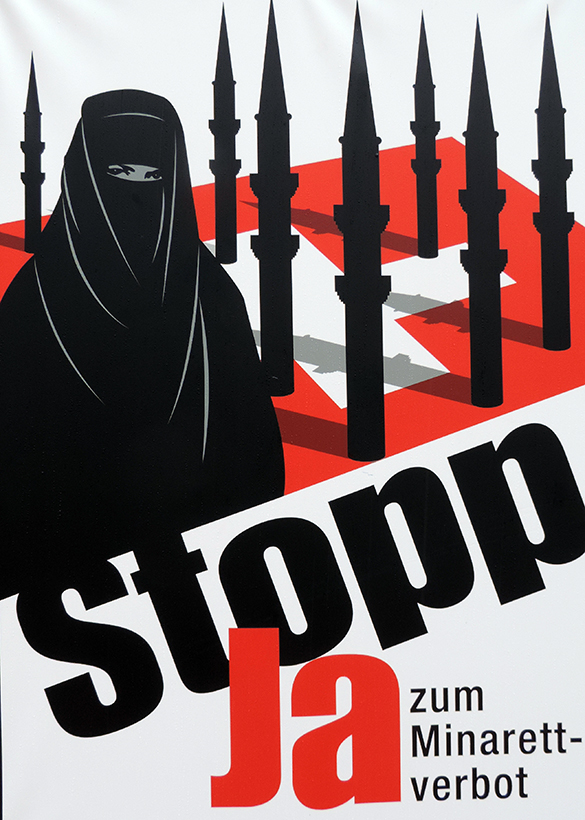
The same politicians really do not want others – especially if the others are muslims – bringing their culture to Switzerland. In 2009, the “Minarets debate” swirled about the limits of multiculturism. A black burqua-ed woman is clearly associated here with those black threatening minaret – missiles awaiting for their deadly countdown. The whole resonates with daily news of fundamental islamic terrorism.
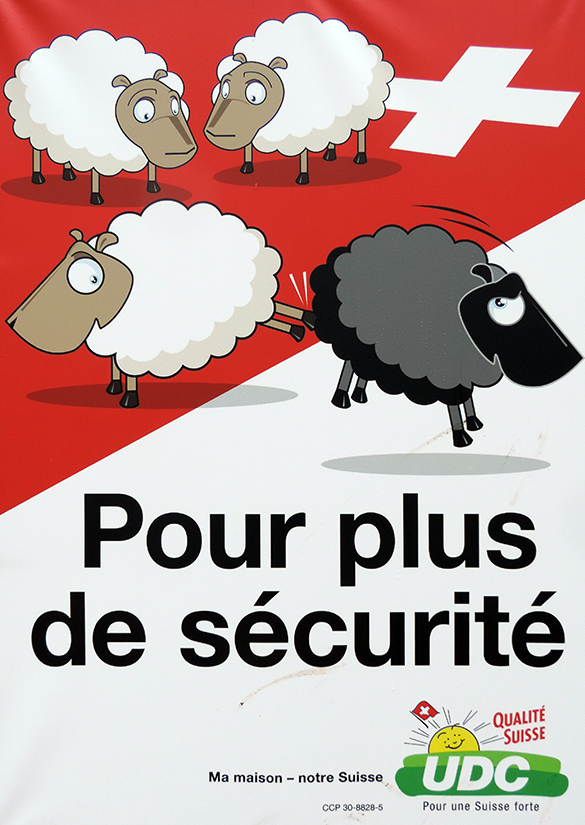
Swiss Political Posters 4

In most countries, displaying this 2007 poster would most likely end in a prison sentence. It is more than controversial. Kindly and innocent white sheep kick a black sheep out of Switzerland with a view to ensuring Swiss people more security. The furrowed brow of the black sheep indicates not surprise but his intent to get back in.

Fear generates loathing. Haven’t these people heard of Allport’s scale? Gordon Allport was an American psychologist who in the 1950s wrote about the nature of prejudice. He described a five step scale of prejudicial behaviour. At step one is “antilocution” – saying bad things to or about people of a minority. At step five on this scale is killing these same people. Come to think of it, maybe they have heard of Allport’s scale! This is just too awful to consider.

Let me emphasise that racial discrimination is not alive and well in Switzerland. The political parties responsible for the posters above are hotly opposed by the majority.
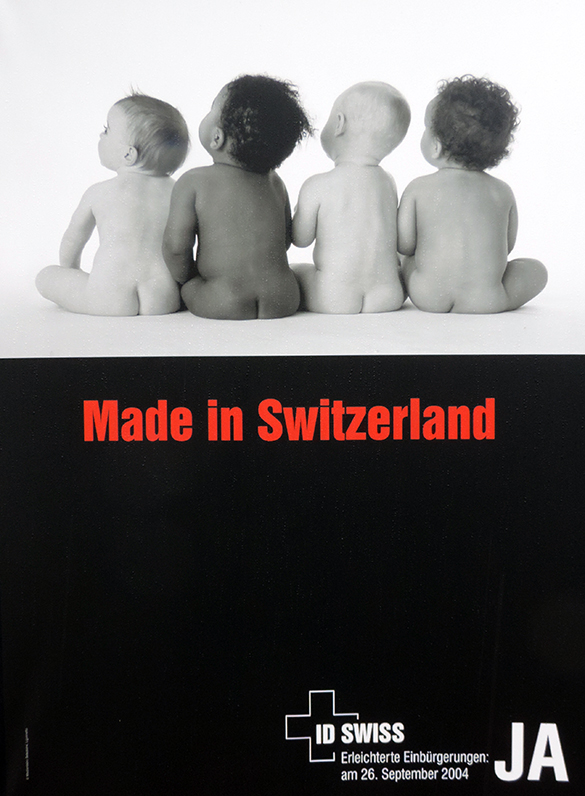
Swiss Political Posters 5

This 2004 anti-discrimination poster is also included in the exhibition. It is effective probably because, in my mind, it is so cute. I love its United Colours of Bennetton recall. The babies are looking up to a united brighter future for their generation in the arms of a soft and cuddly nanny Switzerland.
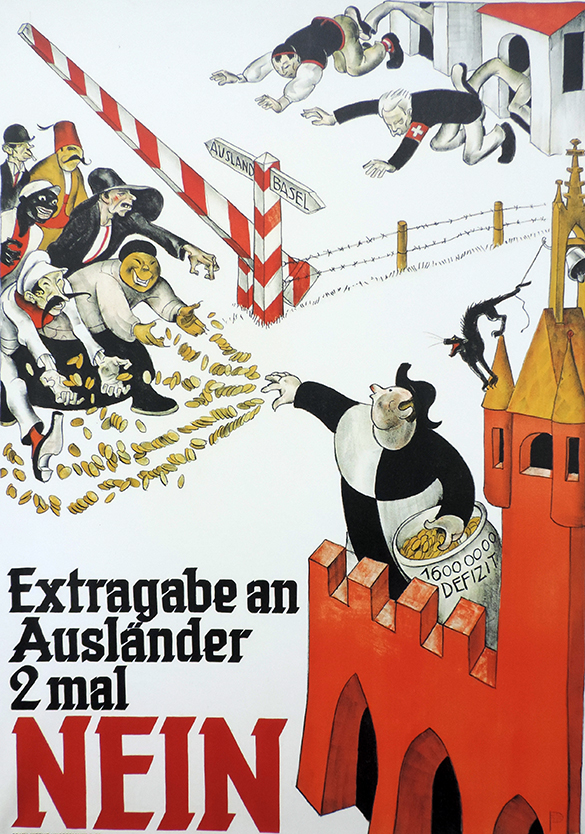
Swiss Political Posters 6

The issue is not new as shown by this poster from 1922. I can’t help being amused by image of the six steroetypical foreigners crossing the border into Basel where gold coin is lavished upon them. A multi-tasking black cat hisses at them and rings a warning bell. In parallel, Swiss people – presumably working in Germany just over the border – are kicked out of their homes.
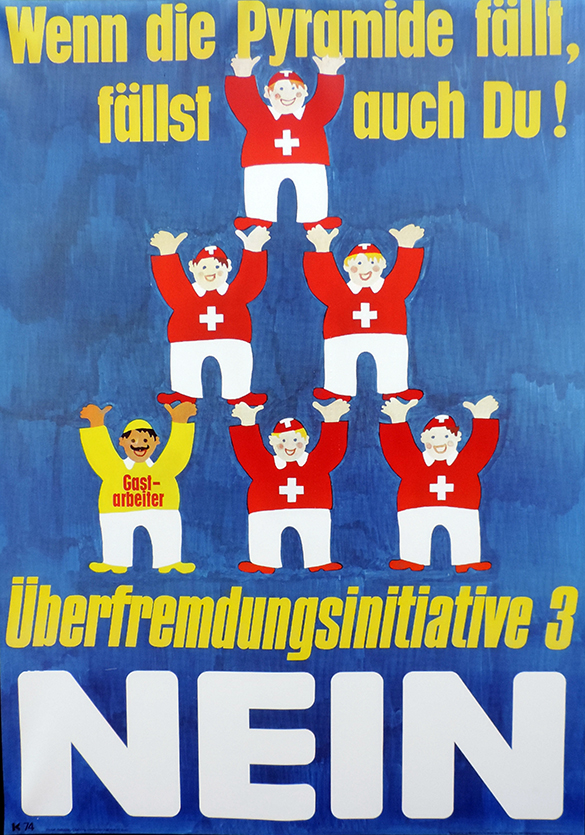
Swiss Political Posters 7

A poster from 1974 warns Swiss citizens that their nice stable economic pyramid should not be supported by “invited” labour. The immigrant labourer remains “invited” as long as he can be marked out by dark skin and thick mustache.
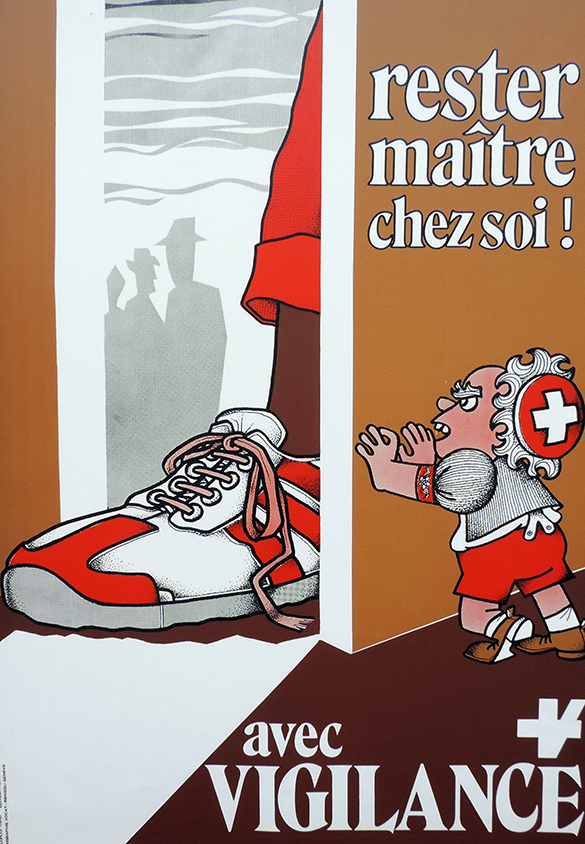
Swiss Political Posters 8

In 1983 those hoping to induce fear of the foreigner show cute traditional little old Switzerland about to be mugged at home by a black – note the skin – youth – note the trainer with frayed lace. The poster also implies that attempting to keep foreigners out is a hopeless task! Any viewer who disaproves or disagrees of the poster is clearly one of the ambivalent grey citizens in the background.

I can’t help reflecting on the unlikely juxtaposition of messages I receive from the news and from these posters. The President of the United States – with darker skin – calms fears about the spread of the loathsome ebola virus. The City of Geneva reminds us that some Swiss politicians clearly aim to stoke fear – and loathing – about people with darker skin. Thanks, Geneva! I know which I fear most!
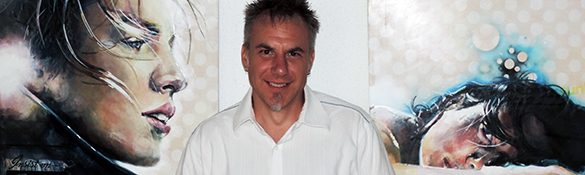
Jeff Schaller: from beeswax to bow-hunting

Jeff Schaller 1

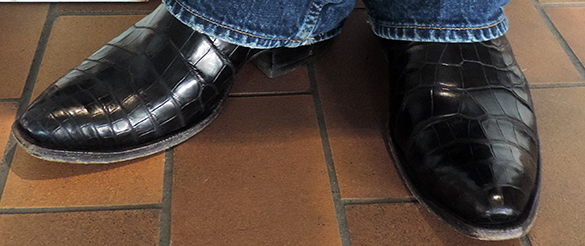
Thanks to Galerie ID, I know the work of James Rizzi and Michael Kalish. Once again, ID brings a major name in American pop art to Geneva. This is Jeff Schaller‘s sixth ID exhibition and, what’s more, these are his only six exhibitions outside the USA. I have the privilege of a rendez-vous with him just before the opening. In the gallery window is “Roses;” it catches my eye from afar. I meet Jeff. Broad smile. Nice guy. I can’t help noticing the shiny aligator-skin boots. Well, he is American!

Jeff Schaller 2

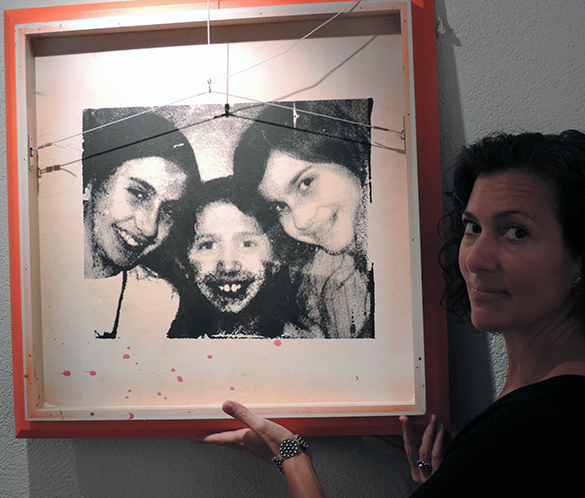
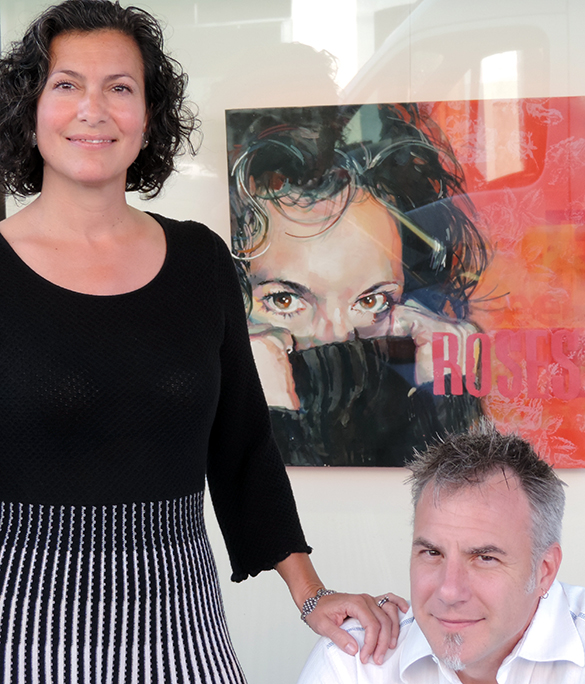
Désirée, Jeff and “Roses” (61cm x 61cm Encaustic on wood) at Galerie ID

Jeff introduces me to Désirée, his muse-spouse and mother of their three children. Nice eyes. Nice lady. The pieces fit together. Désirée is the model for “Roses.”

Jeff is 44 years old. He trained in London and Philadelphia. His initial interest was scientific illustration. It did not take him long to turn his talent to producing images of beautiful women. “I love the hair and the soft skin.” he tells me openly.

Jeff Schaller 3

“Wise” 61cm x 61cm Encaustic on wood

It comes as no surprise when Jeff tells me – with justifiable pride – that Désirée is the model for most of his work. However, the success of his portfolio is not solely due to the beatiful and evocative subject matter. His name is known for his mastery of “encaustic.”  This is a two-thousand year-old technique that works best on wood. It involves the painter making his or her own paint by melting beeswax and adding the pigments. Application is time-critical. The first shot has to be the right shot.There is a fifteen second window of opportunity before the paint dries. In describing the warming of the beeswax, Jeff warms to the subject. It is clearly a technique that matches his temperament. After careful planning and preparation he launches himself into total, intense concentration and commitment. Désirée and the kids know this is not the time to ask him to take a telephone call. Jeff uses words like “viscosity,” “instantaneous” and “confidence.” He tells me the best part of his work and what really gives him a buzz is the moment that he knows he has executed the final lavish stroke. As if to re-run the thrill, he touches his work and invites me to do the same. I already know him well enough to call him “Mister Enthusiasm!” I ask him what one word describes his chosen technique. He thinks for bit and says “Yummy!” and laughs. The result cannot be appreciated on a photo…. so go to the exhibition!

Jeff Schaller 4

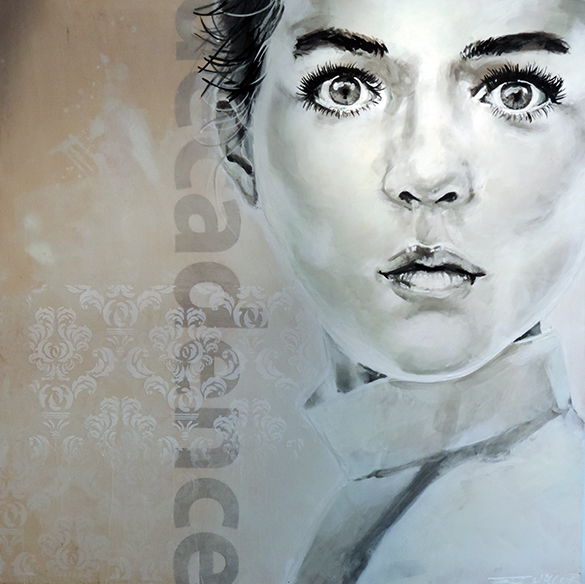
“Decadence” 92cm x 92cm Encaustic on wood

I am drawn into Jeff’s paintings. Each is like one frame of a sumptuous cartoon strip. Each is a puzzle of nostalgia, celebration, sensuality, relationship and the written word. But the puzzle just is. It doesn’t need to be solved. I ask Jeff about his influences. Roy Lichtenstein? Ed Ruscha? Top of his list is Jasper Johns. A major reason is that Johns also used encaustic to great effect; another is that he is reputed to have said “Take something and add to it.” I guess it sums up pop art.

Jeff Schaller 5

Authentication and dating by silkscreen print on reverse side of “Wise”

There is another unique feature to Jeff’s works. None are signed. None are dated. Désirée turns one of the paintings. On the back is a hand printed silk-screen of a recent photo of their three children. Each work is thus authenticated and dated.

Jeff Schaller 6

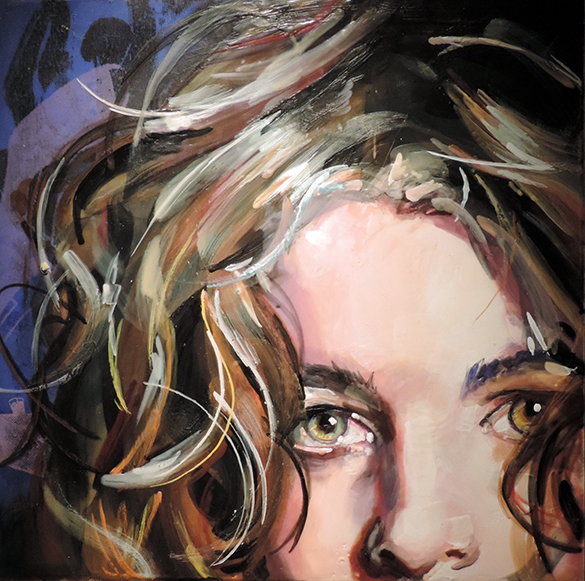
“Head over heels” 30cm x 30cm Encaustic on wood

One painting reminds of the love of my life. I inspect it closely. I am slightly breathless. I explore the hair and the eys with trembling finger tips and… I buy it!

We chat. People arrive. Jeff clearly feels he should mingle. I have a thousand questions. I permit myself one more. “So what do you do when you’re not painting?”  There is a heart beat of hesitation in his smile. “I’m a bit of red-neck!” he replies noting my surprise. “I bow-hunt.” I ask what he hunts. His eyes flick down to his boots. “Aligators!” he says.

Jeff Schaller 7

A stroll in Cambridge (UK)

I am in Cambridge (UK). I am expected at Gonville and Caius College for dinner. I have time. I stroll. Nostalgia settles in.

Cambridge 1

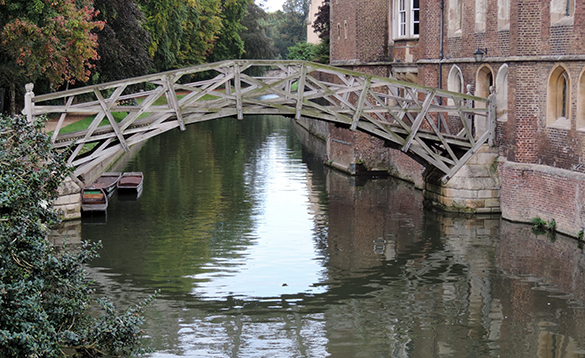
The first thing of great beauty I see is the “Mathematical Bridge” that crosses the River Cam connecting the two parts of Queen’s College. It was designed by William Etheridge, and built by James Essex in 1749. It appears to be an arch but is composed entirely of straight timbers built to an unusually sophisticated engineering design, hence its name. It is so elegant. If some wag tells you that before its rebuilding in 1866 there were neither nuts nor bolts, it is not true: they were just better hidden.

The next thing that catches my eye is a flyer for a lecture that is starting right now as I stroll. Psychologist Steven Pinker from Cambridge (USA) is in town. He is one of the most influential living scientists. His subject is violence. My subject. I would like to go but cannot. I wonder if he cites any of my hard-won data on people in danger. Oh well…. My memory lane crosses the river again.

Cambridge 2

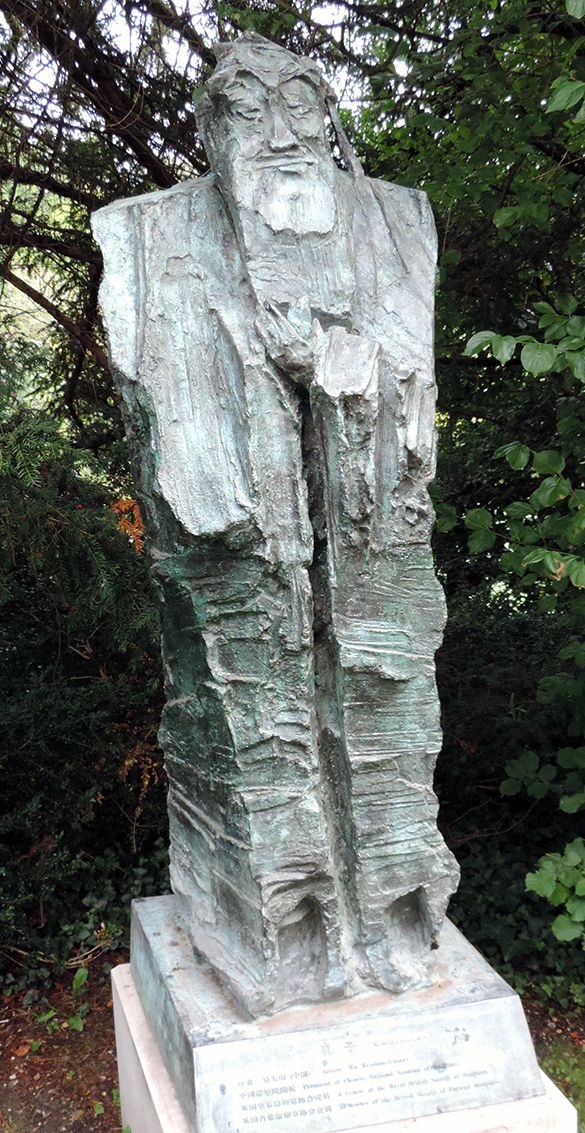
Next to Clare College bridge, I am pulled up by an exquisite sculpture of Confucius (551-479BC) gifted to the college in 2010 by the sculptor Wu Weishan, President of the Chinese Academy of Sculpture. Wu’s Confucius has already survived four Cambridge (UK) winters. He seems to be enjoying his outdoor séjour in this seat of learning. The sculpture is, at first impression, rough and raw. I run my hands gratifyingly over the chunky silk gown. I examine the face; it emmanates a sense of humour. This Confucius could even be a bit of a rascal; there is something piratical about that smile. At the same time, he seems to be on the point of saying something really profound. But it’s the hands that really draw me in to this work. They are delicate and inwardly turned; a message of sincerity. This is a man who brought notions of morality, governance and justice to large swathes of the world.

Cambridge 3

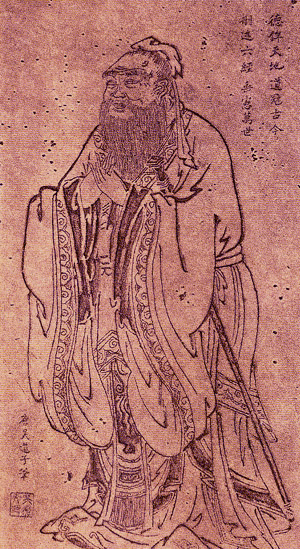
I guess that Wu would not have had photos to work with. I would put money on him basing his sculpture on this ancient wood print of Confucius from Wu Daozi (680-740AD).

On to Gonville and Caius.

Cambridge 4

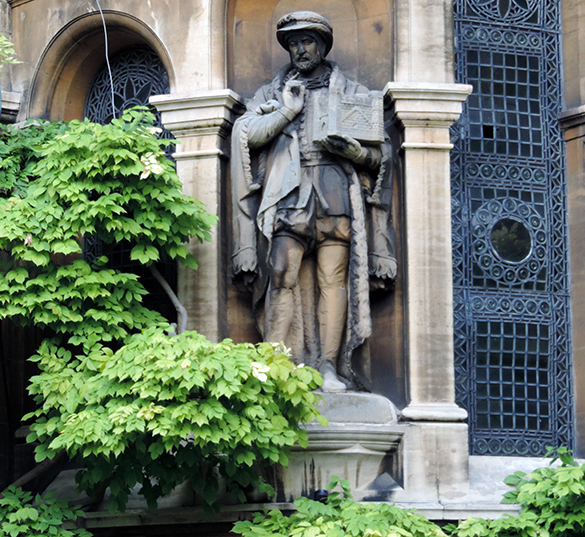
In “Tree Court” there is a striking statue of the physician William Harvey (1578-1657.) He was quite some guy. He worked out that blood was pumped around the body by the heart. He described this research as “an arduous task.” In 1628, he published a monument of medical science under the title “On the Motion of the Heart and Blood.”

Cambridge 5

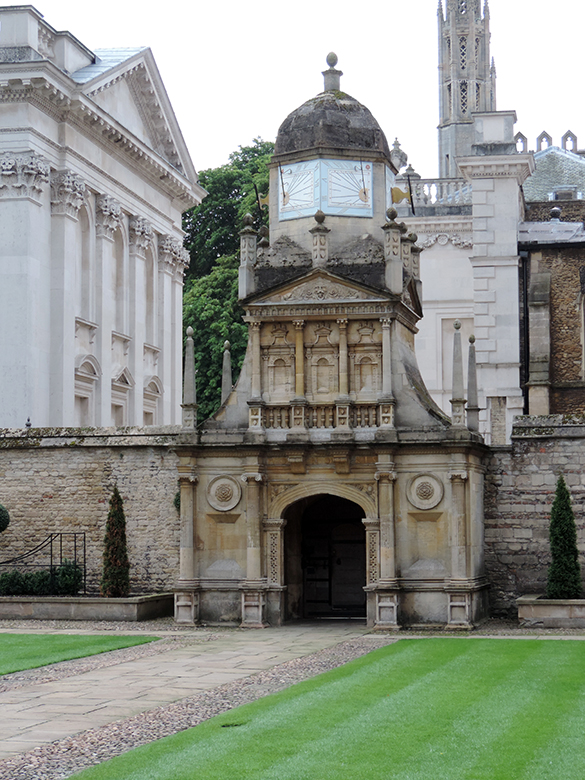
The College’s Gate of Honour is very beautiful in its proportion and detail. It was commissioned by the good Dr Caius himself in 1565. The designer is not known. It is only opened once per year on Graduation Day and I once walked through it giving little thought to the mathematically intriguing six sundials on the hexagonal facets of the tower atop the gate. I am dizzy from this all-about tradition, beauty, knowledge and learning. Then I mount the oak stairs into the dining hall of Gonville and Caius.

Cambridge 6

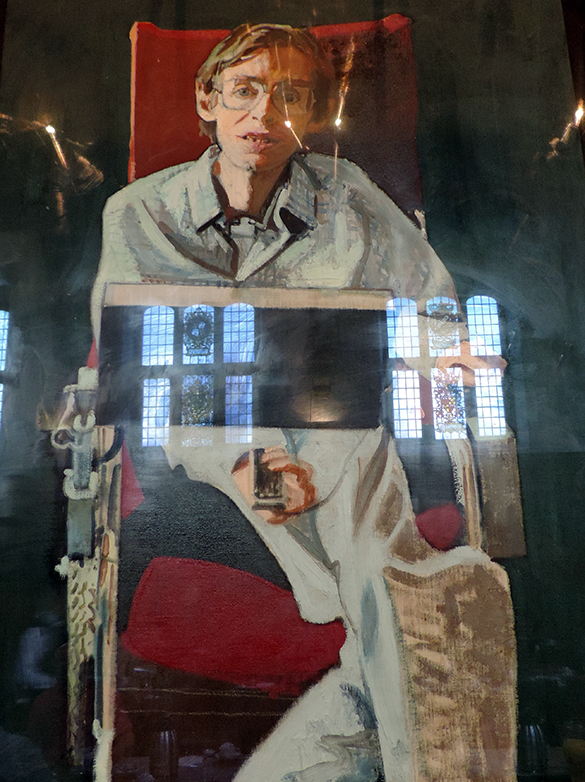
The last rays of the day’s sun filter through the hall’s high windows illuminating a huge portrait of another genius of the College. Stephen Hawking peers down from on high. The painter (unknown) has captured well that famous cheeky-geeky face. Using warm colours, he has cleverly portrayed the contorted body resting comfortably in a high-tech wheel chair. Hawking was the first to set forth a cosmology explained by a union of the general theory of relativity and quantum mechanics. (I stole this last sentence from an authoritative source and – like most people who have it on their bookshelves – did not get far beyond the first page of “A Brief History of Time.”) Unsurprisingly, his work shook his – and his wife’s – religious beliefs.

Cambridge. So much learning. So much knowledge. Such beautiful testament to learning and advances in knowledge. This is stuff that, once discovered and over time, we all come to believe. But somehow, in the back of my mind, is that flyer about the lecture I am missing. Violence. Belief and violence. Harvey changed what we believe about the human body. Hawking changed what we believe about the universe. At another time or in another place, both would have had all forms of violence visited upon them precisely because they challenged existing beliefs. What is it about belief – scientific, theological or political – that ferments such profound emotions? Why are differences in what we believe the principal generator of large scale violence? Belief and violence. Perhaps Steven Pinker of Cambridge (USA) has the answer?